
KAIST Scholarship 2027: Full Guide for International Students
The KAIST Scholarship is one of the major funding opportunities available to international students who want to study science, engineering, technology, business, and related fields in South Korea.
KAIST, officially known as the Korea Advanced Institute of Science and Technology, offers financial support to eligible international students at undergraduate, Master’s, integrated Master’s-PhD, and PhD levels.
For students searching for KAIST Scholarship international students opportunities, one of the main advantages is that scholarship consideration is closely connected with the university admission process. Undergraduate applicants do not need to complete a completely separate scholarship application. Graduate applicants can also indicate the KAIST funding option when submitting their admission application.
The financial support can include full tuition, monthly living support, and health insurance. However, the exact benefits depend on the degree level and scholarship category.
This guide explains the KAIST Scholarship eligibility requirements, benefits, degree levels, application process, documents, deadlines, English language requirements, selection procedure, and important points applicants should know before applying.
What Is the KAIST Scholarship?
The KAIST Scholarship is financial assistance provided by KAIST to support qualified students during their studies at the university.
International applicants can be considered for funding through KAIST’s international admission system.
For undergraduate students, the standard scholarship currently provides tuition exemption for eight semesters, monthly living expenses of KRW 350,000, and medical health insurance.
Graduate funding is structured differently. The standard graduate KAIST Scholarship provides full tuition coverage, National Health Insurance support, and a monthly stipend. The amount of the graduate stipend can depend on the student’s research involvement and college or department.
Students researching KAIST Scholarship international students should therefore check the scholarship rules for their specific academic level instead of assuming that undergraduate and graduate students receive exactly the same funding package.
About KAIST
The Korea Advanced Institute of Science and Technology was established in 1971 and is located primarily in Daejeon, South Korea.
KAIST focuses heavily on science, technology, engineering, innovation, entrepreneurship, and research.
The university includes undergraduate and graduate programmes across areas such as engineering, natural sciences, computing, life sciences, business, and interdisciplinary research.
International students are an important part of the KAIST community, and the university provides dedicated international admission routes and financial support.
This makes the KAIST Scholarship international students opportunity particularly attractive to applicants interested in research-intensive programmes.
KAIST Scholarship for International Students
The KAIST Scholarship is available through both undergraduate and graduate international admissions.
However, the structure differs according to degree level.
Undergraduate applicants may receive:
- Full tuition exemption
- Monthly living allowance
- Medical health insurance
Graduate applicants selected for KAIST financial support may receive:
- Full tuition coverage
- National Health Insurance
- Monthly financial support
- Research-related financial assistance depending on the department or laboratory
The standard KAIST Scholarship international students funding should not automatically be interpreted as including every possible study expense.
For example, international airfare is not listed as a standard benefit of the main undergraduate or general graduate scholarship. Certain special programmes may provide travel support, but applicants should distinguish those programmes from the normal KAIST scholarship.
Degree Levels Available
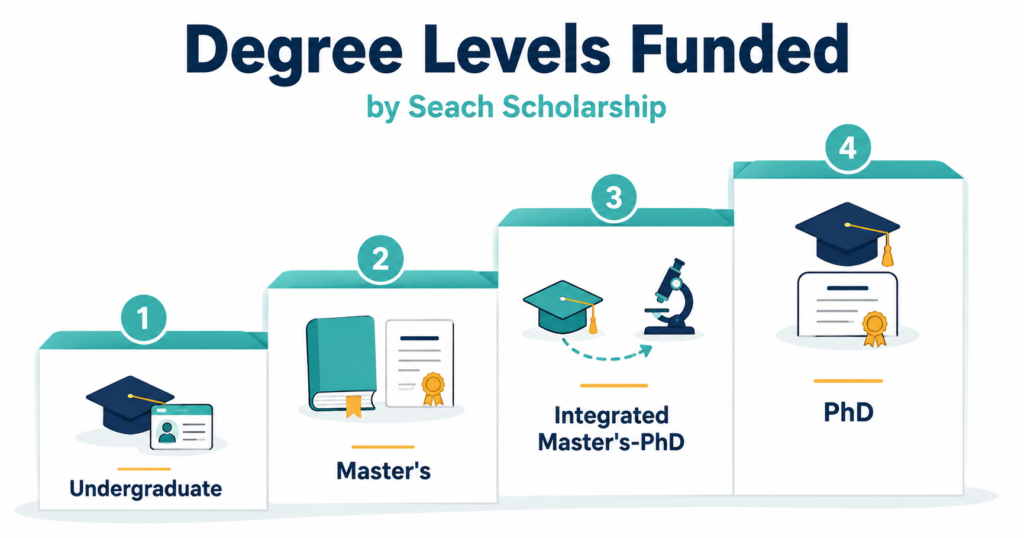
Students can pursue KAIST funding at different academic levels.
Undergraduate
International students applying for a Bachelor’s programme can request scholarship consideration as part of their admission application.
Master’s
International graduate students applying for a Master’s programme can select the KAIST funding option during the application process.
Master’s-PhD Integrated Programme
Students interested in progressing directly through graduate research may apply to an integrated Master’s-PhD programme where available.
PhD
International students who already possess the required Master’s-level qualification can apply for doctoral admission and relevant KAIST financial support.
The KAIST Scholarship international students route therefore covers students at several stages of higher education.
KAIST Undergraduate Scholarship Benefits
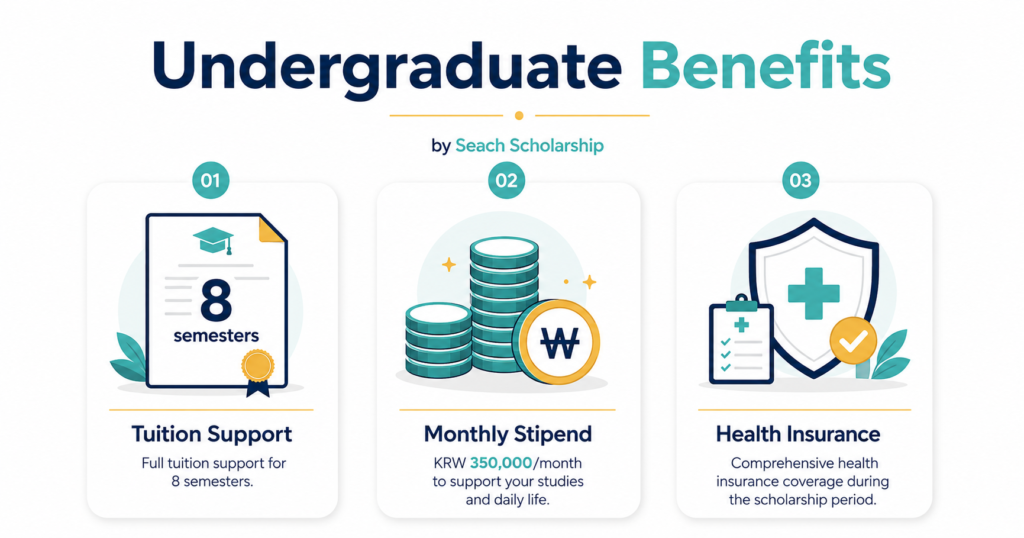
The undergraduate KAIST Scholarship currently offers three main benefits.
1. Full Tuition Fee
Scholarship recipients receive a tuition exemption for eight semesters.
This can cover the normal duration of an undergraduate degree provided that the student continues to satisfy the required conditions.
2. Monthly Living Expenses
Undergraduate scholarship recipients receive:
KRW 350,000 per month
The monthly allowance can help students cover expenses such as food, transportation, personal items, and other basic costs.
3. Medical Health Insurance
The scholarship also provides medical health insurance support.
These benefits make the undergraduate KAIST Scholarship international students programme a substantial financial support option for applicants who would otherwise find overseas tuition difficult to finance.
Does the Undergraduate Scholarship Cover Four Years?
The tuition benefit is available for up to eight semesters.
Eight regular semesters normally correspond to four academic years.
Students must, however, continue to satisfy KAIST’s academic requirements.
After the freshman year, scholarship students are required to maintain a GPA above 2.7 out of 4.3 according to the current KAIST undergraduate scholarship rules.
Students considering the KAIST Scholarship should therefore understand that receiving the award at admission does not remove the need to maintain satisfactory academic performance.
KAIST Graduate Scholarship Benefits
Graduate students have a different funding structure.
The general graduate KAIST Scholarship provides:
- Full tuition coverage
- National Health Insurance
- Monthly stipend
- Potential additional support connected with research participation
The university states that the monthly stipend can depend on research involvement and that funding levels may differ among colleges.
The KAIST Scholarship international students graduate option is available across KAIST departments except where a particular programme has separate financial arrangements.
International applicants select the KAIST scholarship as their financial resource during the graduate admission application.
Eligible admitted candidates may then also be considered for additional KAIST scholarship categories.
KAIST Global Presidential Scholarship
The KAIST Global Presidential Scholarship, commonly referred to as KGPS, is a highly competitive graduate scholarship.
It is intended for international applicants entering:
- Master’s programmes
- Master’s-PhD integrated programmes
Eligible candidates who choose the KAIST Scholarship in their admission application can automatically be considered for KGPS.
There is no separate KGPS application for eligible applicants.
KGPS Benefits
Selected students currently receive:
- Full tuition coverage
- KRW 1,000,000 monthly stipend
- Support for four regular semesters
Only highly competitive applicants are normally recommended for this award by the relevant department.
Students searching for KAIST Scholarship international students should therefore understand the difference between general KAIST financial support and the more competitive KGPS award.
KAIST Prestige Scholarship for International PhD Students
KAIST also operates the KAIST Prestige Scholarship for International PhD Students, known as KPS.
It is available to eligible international applicants entering:
- Master’s-PhD integrated programmes
- PhD programmes
KPS Benefits
The current benefits include:
- Full tuition coverage
- KRW 300,000 monthly stipend
- Support for eight regular semesters
For students entering an integrated Master’s-PhD programme, this particular scholarship begins when they enter the PhD stage.
Applicants demonstrating strong academic and research achievements may be recommended by their department, with final selection handled through the relevant KAIST process.
For research-focused KAIST Scholarship international students, KPS can provide additional support during doctoral study.
Who Can Apply for the KAIST Scholarship?
Eligibility depends on whether the applicant is applying for undergraduate or graduate admission.
The most important point is that applicants must first qualify for KAIST international admission.
Receiving scholarship consideration does not replace the normal university admission requirements.
KAIST Undergraduate Scholarship Eligibility
The undergraduate KAIST Scholarship is available to applicants applying through International Student Admission.
For 2027 admission, international applicants must satisfy KAIST’s citizenship and educational requirements.
Educational Requirement
For Spring 2027 admission, candidates must have graduated or be expected to graduate from high school by February 28, 2027.
For Fall 2027 admission, candidates must have graduated or be expected to graduate from high school by August 31, 2027.
Citizenship Requirement
Applicants holding Korean citizenship, including dual Korean citizenship, are not eligible to apply as foreign students through this route.
International applicants must additionally satisfy KAIST’s rules relating to parental citizenship or education outside Korea.
In general, an international applicant must meet one of the university’s recognised conditions, such as having parents who are not Korean citizens.
Special provisions apply to applicants of Korean origin.
Applicants interested in KAIST Scholarship international students funding should carefully review these citizenship requirements before paying an application fee or preparing documents.
Can International Students Transfer to KAIST?
KAIST currently states that it does not operate an international undergraduate transfer programme.
International applicants must apply as freshman students.
This point is particularly important for students already studying at another university who are considering the undergraduate KAIST Scholarship.
Applicants should check whether they remain eligible to enter KAIST under the freshman admission rules.
KAIST Graduate Scholarship Eligibility
Graduate applicants must meet KAIST’s international graduate admission requirements.
Citizenship
Applicants must be citizens of countries other than South Korea.
People holding Korean citizenship are not eligible for KAIST International Graduate Admissions.
Additional rules apply to applicants of Korean descent who hold foreign citizenship.
Master’s Degree Applicants
Applicants for a Master’s or Master’s-PhD integrated programme must hold a Bachelor’s degree or an equivalent recognised qualification by the beginning of their programme.
PhD Applicants
Applicants for a PhD programme must hold a Master’s degree or an equivalent qualification by the beginning of the programme.
Meeting these requirements allows applicants to pursue graduate admission and request consideration for KAIST Scholarship international students funding.
KAIST English Language Requirements
English is the official language of communication and instruction for international graduate students at KAIST.
Graduate applicants are generally required to provide an accepted English proficiency score unless they qualify for an exemption.
Accepted tests currently include:
- TOEFL
- IELTS Academic
- TOEIC
- TEPS
For IELTS Academic, the current minimum listed by KAIST is:
IELTS Academic: 6.5
The current minimum TOEIC Listening and Reading requirement is:
TOEIC: 720
KAIST also accepts qualifying TOEFL and TEPS scores according to the current admissions rules.
Applicants should check the latest score table before submitting their application because test formats, score reporting rules, and exemptions can change.
Can Applicants Receive an English Test Waiver?
Yes.
Certain graduate applicants may qualify for an English proficiency test exemption based on citizenship and/or previous education.
KAIST currently maintains lists of countries whose applicants may qualify for exemption under specified conditions.
Pakistan, India, the Philippines, Sri Lanka, and several other countries appear within one of KAIST’s exemption categories where applicants must also satisfy the stated English-medium education requirements.
Applicants should not assume that nationality alone guarantees an exemption.
Students pursuing KAIST Scholarship international students funding should check the latest KAIST English proficiency exemption rules and obtain a Medium of Instruction or English Lecture Certificate when required.
Documents Required for KAIST Scholarship
Because scholarship consideration is connected with admission, applicants should focus primarily on preparing a strong and complete admission application.
Depending on degree level and applicant circumstances, documents may include:
- Online application form
- Academic transcripts
- Graduation certificate or expected graduation documentation
- Identification and citizenship documents
- Parent or family citizenship documentation where required
- Recommendation letter
- English proficiency evidence where applicable
- Academic achievements or supporting materials
- Statement or application essays required by KAIST
- Additional programme-specific documents for graduate applicants
Applicants should always use the checklist contained in the admission guide for their exact admission cycle.
Do not submit an old checklist simply because it appeared in a previous KAIST Scholarship guide.
Is a Recommendation Letter Required?
Recommendation forms are part of the KAIST international admission system.
Applicants should choose a recommender who can provide credible information about their academic ability, motivation, research potential, problem-solving skills, or preparation for university study.
A strong recommendation is particularly important because the KAIST Scholarship international students selection process is closely linked to the overall admission review.
Applicants should contact recommenders early rather than waiting until the final submission date.
Get Your Free Guide Now
Enter your details and we'll send the complete step-by-step guide straight to your inbox.
How to Apply for KAIST Scholarship
The application procedure differs slightly for undergraduate and graduate applicants, but in both cases the scholarship request is connected with the admission application.
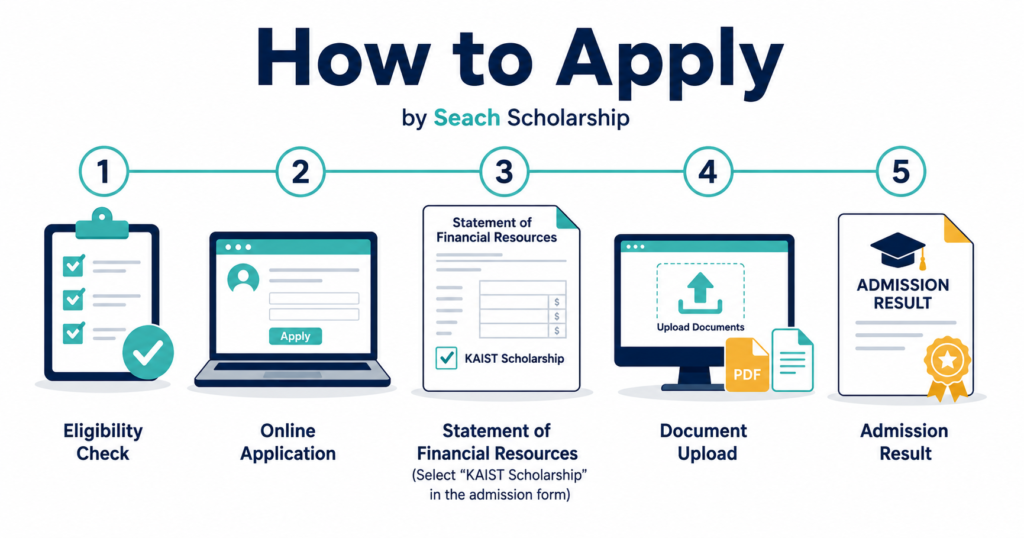
Undergraduate Application Process
Step 1: Confirm Eligibility
Check your citizenship, high school graduation date, and other international admission conditions.
Step 2: Choose an Admission Track
KAIST offers different application tracks depending on the semester and admission cycle.
Step 3: Complete the Online Application
Create an account through the official KAIST international undergraduate application system and complete the required sections.
Step 4: Request the KAIST Scholarship
In the Statement of Financial Resources section, select or check:
KAIST Scholarship
There is no separate undergraduate scholarship application.
Step 5: Prepare Supporting Documents
Upload or submit the required academic and personal documents according to the application guide.
Step 6: Arrange the Recommendation
Make sure your recommendation is submitted within the separate recommendation deadline.
Step 7: Submit the Application
Complete the application and required document submission before the deadline.
Step 8: Attend an Interview if Requested
KAIST may invite selected applicants for an online interview.
An interview is not required for every applicant.
Step 9: Check the Admission Result
Applicants selected for admission and scholarship support will receive the relevant information from KAIST.
This relatively integrated process is one of the advantages of the undergraduate KAIST Scholarship international students route.
Graduate Application Process
Graduate applicants can follow these steps.
Step 1: Choose a Graduate Programme
Identify the Master’s, integrated Master’s-PhD, or PhD programme that matches your academic background and research interests.
Step 2: Review Department Requirements
Graduate applicants should study the research areas, laboratories, professors, and department-specific expectations.
Step 3: Check Admission Eligibility
Confirm citizenship, previous degree requirements, and English proficiency requirements.
Step 4: Prepare Academic Documents
Prepare your transcripts, degree documentation, English proficiency evidence, recommendation materials, and other documents requested by KAIST.
Step 5: Complete the Online Application
Apply through the KAIST international graduate admissions system.
Step 6: Select KAIST Scholarship
Choose the KAIST Scholarship as your financial resource when completing the graduate admission application.
Step 7: Submit the Application
Complete all parts of the application within the official deadline.
Step 8: Scholarship Consideration
Eligible admitted applicants who selected KAIST funding can automatically be considered for relevant scholarship programmes such as KGPS or KPS depending on their degree and profile.
For graduate KAIST Scholarship international students, academic achievement and research potential can be especially important.
KAIST Scholarship Deadline for 2027 Undergraduate Admission
KAIST has published the undergraduate schedule for 2027 admissions.
Early Admission
Application and document submission:
September 22, 2026 – October 22, 2026 at 6:00 PM KST
Recommendation deadline:
October 29, 2026 at 6:00 PM KST
Interview if required:
December 22, 2026
Admission announcement:
January 7, 2027 at 10:00 AM KST
Regular Fall Admission
Application and document submission:
November 10, 2026 – January 14, 2027 at 6:00 PM KST
Recommendation deadline:
January 21, 2027 at 6:00 PM KST
Interview if required:
March 3, 2027
Admission announcement:
March 25, 2027 at 10:00 AM KST
Applicants should convert Korean Standard Time to their local time and avoid submitting the KAIST Scholarship application at the last minute.
KAIST also states that admission announcement dates may be changed.
KAIST Graduate Scholarship Deadline for 2027
KAIST currently lists the general international graduate admission periods as follows:
- Spring Admission: Mid-August to early September
- Fall Early Admission: Early December to late December
- Fall Regular Admission: Early March to late March
For Spring 2027 Entry, the published graduate application period is:
August 18 – September 1, 2026
At the time of writing, KAIST lists the Fall 2027 graduate entry dates as TBA.
Applicants interested in graduate KAIST Scholarship international students opportunities should therefore monitor the official graduate admissions timeline rather than relying on a deadline copied from an earlier year.
Is There a Separate KAIST Scholarship Application?
For the main undergraduate scholarship, no separate scholarship application is required.
Applicants need to indicate KAIST Scholarship in the Statement of Financial Resources section of the admission application.
For general graduate KAIST funding, applicants similarly select the KAIST scholarship option as their financial resource.
Eligible graduate applicants can then be automatically considered for relevant funding categories such as KGPS and KPS.
This is one of the most important points to remember when researching KAIST Scholarship international students applications.
How Are KAIST Scholarship Applicants Selected?
KAIST evaluates scholarship applicants through the university admission review.
Undergraduate applications are reviewed as part of the international admission process.
KAIST states that applications are thoroughly and equally reviewed and that students selected for admission after requesting KAIST funding become entitled to the undergraduate scholarship.
Graduate scholarship selection can depend on the programme, department, academic record, research preparation, and particular scholarship category.
More competitive awards such as KGPS and KPS involve additional departmental or university-level selection.
What GPA Is Required to Keep the Undergraduate Scholarship?
After the freshman year, undergraduate scholarship students must maintain a GPA above:
2.7 out of 4.3
Students should take this condition seriously.
Winning the KAIST Scholarship is only the beginning. Maintaining the award requires continued academic performance.
What GPA Is Required for Graduate Students?
Graduate funding conditions can vary according to the specific scholarship, department, laboratory, or funding programme.
Applicants should therefore read the funding conditions contained in their admission and scholarship documents.
Students receiving specialised KAIST Scholarship international students awards should pay particular attention to any GPA, research, or programme continuation requirements.
Does KAIST Scholarship Cover Airfare?
International applicants should not assume that the standard KAIST Scholarship includes international airfare.
The main undergraduate scholarship lists tuition, monthly living expenses, and medical health insurance.
The standard graduate funding package lists tuition, National Health Insurance, and a monthly stipend.
Some specialised KAIST programmes funded through governments, companies, or external organisations can include airfare, relocation expenses, or additional allowances.
These special programmes have separate eligibility requirements.
Is the KAIST Scholarship Fully Funded?
The KAIST Scholarship is often described as a fully funded opportunity because its main packages provide substantial tuition and living support.
However, applicants should understand exactly what is included.
Undergraduate funding includes full tuition for eight semesters, KRW 350,000 per month, and medical health insurance.
Graduate funding generally includes full tuition, health insurance, and a monthly stipend.
Expenses not specifically listed by KAIST should not automatically be considered covered.
Can Pakistani Students Apply?
Yes, Pakistani students can apply if they satisfy the international admission requirements.
The KAIST Scholarship international students programme is not restricted to applicants from only a small list of countries.
Pakistani applicants should check the citizenship, academic qualification, document, and English proficiency requirements for their intended programme.
Graduate applicants from Pakistan may also qualify for KAIST’s English proficiency exemption under specified conditions when their previous qualifying education meets the university’s English-medium requirements.
Can Students From Any Country Apply?
International applicants from countries other than Korea may generally apply provided that they meet KAIST’s international admission eligibility rules.
Special rules apply to Korean citizens, dual citizens, and applicants of Korean origin.
Applicants should verify their status before starting a KAIST Scholarship application.
Tips for a Strong KAIST Scholarship Application
Build a Strong Academic Record
KAIST is a science- and research-focused institution.
Strong academic preparation in subjects related to your proposed field can strengthen your application.
Demonstrate Academic Curiosity
Show how your previous studies, projects, competitions, research, or independent learning developed your interest in the programme.
Do Not Submit Generic Essays
Your application should explain why KAIST and the chosen academic direction are appropriate for you.
Avoid submitting the same generic statement to several universities.
Highlight Research Experience
Research experience is particularly useful for graduate KAIST Scholarship international students applications.
Explain the problem you studied, your role, methodology, skills, and results rather than simply listing a research project title.
Choose Recommenders Carefully
A detailed academic recommendation is usually more valuable than a general letter from someone who does not know your academic work.
Check Every Document
Names, dates, degree titles, citizenship information, test scores, and programme information should be consistent throughout the application.
Apply Early
Do not wait until the final hours before the deadline.
Technical problems, missing documents, payment issues, or recommendation delays can make a strong application incomplete.
Common KAIST Scholarship Mistakes
Applicants should avoid:
- Missing the admission deadline
- Forgetting the recommendation deadline
- Selecting the wrong admission track
- Assuming admission and scholarship have separate deadlines
- Uploading unclear academic documents
- Providing inconsistent citizenship information
- Ignoring English proficiency requirements
- Assuming IELTS is mandatory without checking exemption eligibility
- Assuming airfare is automatically covered
- Using outdated scholarship amounts
- Submitting generic application essays
- Ignoring department-specific graduate requirements
- Waiting until the last day to contact a recommender
- Failing to check the official KAIST application guide
Frequently Asked Questions
What is the KAIST Scholarship?
The KAIST Scholarship is financial support provided to eligible students studying at the Korea Advanced Institute of Science and Technology. Depending on the degree level, it can include tuition, monthly financial support, and health insurance.
Is KAIST Scholarship available for international students?
Yes. KAIST Scholarship international students funding is available through KAIST’s international undergraduate and graduate admission routes.
Is KAIST Scholarship fully funded?
It provides substantial funding. Undergraduate recipients receive full tuition for eight semesters, KRW 350,000 monthly living support, and medical health insurance. Graduate support generally includes full tuition, health insurance, and a monthly stipend.
How much is the KAIST undergraduate monthly stipend?
The current undergraduate KAIST Scholarship living allowance is KRW 350,000 per month.
How much does KGPS provide?
The KAIST Global Presidential Scholarship currently provides full tuition and a monthly stipend of KRW 1,000,000 for four regular semesters.
Who can receive KGPS?
International applicants entering eligible Master’s or Master’s-PhD integrated programmes can be considered.
Does KAIST Scholarship require IELTS?
Not every applicant must submit IELTS. Graduate students may use other accepted English tests, and some applicants can qualify for an English proficiency exemption.
What IELTS score does KAIST require for graduate admission?
The current listed IELTS Academic minimum is 6.5.
Is there an application for KAIST Scholarship international students separate from admission?
For the standard undergraduate scholarship, there is no separate scholarship application. Applicants request scholarship consideration in the admission application. Graduate applicants also select KAIST funding in the financial resource section.
Can undergraduate students choose their major after admission?
KAIST states that undergraduate students remain undeclared during their freshman year and can choose their major after the second semester. There is no quota for each department or major under the current international undergraduate admission information.
Can transfer students apply?
KAIST currently does not offer an international undergraduate transfer programme. International students must apply as freshman applicants.
Does KAIST Scholarship cover flight tickets?
Standard KAIST Scholarship international students benefits do not list airfare as part of the normal undergraduate or general graduate scholarship package. Certain specialised programmes may provide airfare.
Can Pakistani students apply for KAIST Scholarship?
Yes. Pakistani applicants can apply if they meet KAIST’s international admission requirements.
What is the 2027 undergraduate deadline?
Early applications run from September 22 to October 22, 2026. The regular Fall application period runs from November 10, 2026 to January 14, 2027.
What is the Spring 2027 graduate deadline?
The currently published Spring 2027 graduate application period is August 18 to September 1, 2026.
When is the Fall 2027 graduate deadline?
KAIST currently lists the Fall 2027 international graduate application dates as TBA.
Is the KAIST Scholarship competitive?
Yes. Admission to KAIST is selective, and additional graduate awards such as KGPS and KPS are especially competitive. Applicants should present strong academic preparation, relevant research experience where applicable, and a carefully prepared application.
Final Thoughts
The KAIST Scholarship provides international students with an opportunity to study at one of South Korea’s major science and technology universities while receiving significant financial support.
Undergraduate students can receive full tuition for eight semesters, KRW 350,000 in monthly living expenses, and medical health insurance. Graduate students can receive full tuition, health insurance, and monthly financial support, while highly competitive students may also be considered for programmes such as KGPS or KPS.
One major advantage of the KAIST Scholarship international students application process is that students generally request KAIST funding through the admission application rather than completing an entirely separate scholarship procedure.
Applicants should still prepare carefully. Check your citizenship eligibility, academic qualifications, English language requirements, recommendation arrangements, required documents, scholarship conditions, and admission deadline before submitting the application.
Most importantly, use the official KAIST admission guide for your exact admission cycle. Scholarship benefits, application dates, documentation requirements, and programme rules can change from one admission year to another.
A strong KAIST Scholarship application is not simply an application for financial assistance. It should demonstrate that you have the academic preparation, motivation, research potential, and future direction required to succeed at KAIST.