
Stipendium Hungaricum Scholarship: Full Guide for International Students
The Stipendium Hungaricum Scholarship gives international students the opportunity to study at universities in Hungary with substantial financial support from the Hungarian Government.
The programme covers a wide range of academic levels, including Bachelor’s, Master’s, one-tier Master’s, doctoral and selected non-degree studies. Hundreds of programmes are available through participating Hungarian universities, with many courses taught in English.
One feature that makes Stipendium Hungaricum different from many international scholarships is its country-based application system. You cannot simply choose any programme because your nationality determines which study levels and subject areas you are permitted to apply for.
Applicants therefore need to check two things before preparing documents: whether their country participates in the programme and whether their chosen degree level and field are included under the agreement for that country.
This guide explains the Stipendium Hungaricum Scholarship benefits, eligible countries, Bachelor’s and Master’s routes, application requirements, documents, selection procedure, motivation letter, recommendation letters, CV, Statement of Purpose, application fees and other important information.
What is Stipendium Hungaricum?
The Stipendium Hungaricum Scholarship is an international higher-education scholarship funded by the Hungarian Government.
The Stipendium Hungaricum Scholarship was created to strengthen educational links between Hungary and partner countries while giving international students access to Hungarian higher education.
The programme operates through agreements between Hungary and participating countries, territories and organisations known as Sending Partners.
More than 100 Sending Partners currently participate across five continents, and eligibility differs according to the agreement made with each partner.
Students may find opportunities in areas such as:
- Engineering
- Computer Science
- Information Technology
- Business
- Economics
- Natural Sciences
- Social Sciences
- Agriculture
- Humanities
- Education
- Arts
- Health Sciences
- Medicine
- Pharmacy
- Dentistry
- Architecture
- Law
- Veterinary studies
The actual programmes available to an applicant depend on nationality and the current agreement with the relevant Sending Partner.
Current Stipendium Hungaricum Application Status
The latest standard application cycle currently published by Stipendium Hungaricum is for the 2026/2027 academic year.
Applications for that intake closed on 15 January 2026 at 2:00 PM Central European Time, with successful students beginning their studies in Hungary in 2026.
The official website has not yet published the standard 2027/2028 call at the time this guide is being prepared.
Future applicants should therefore avoid assuming that the previous deadline, eligible programmes or document rules will remain exactly the same.
Use previous calls to prepare, but confirm everything again when the new application announcement becomes available.
Stipendium Hungaricum Scholarship Benefits
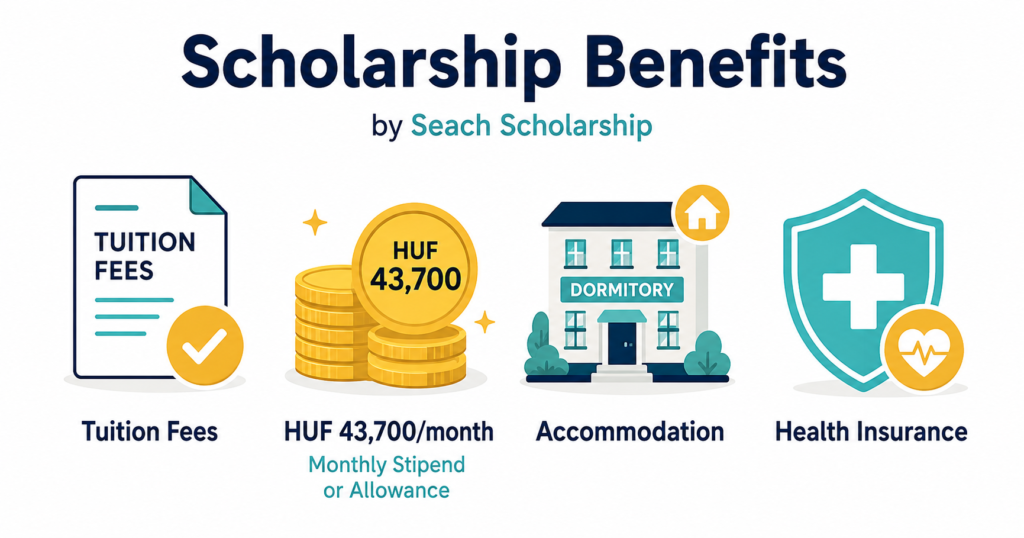
The Stipendium Hungaricum Scholarship provides several forms of financial support.
For Bachelor’s, Master’s, one-tier Master’s and eligible non-degree students, the current support package includes:
Tuition Coverage
Scholarship holders do not pay the normal tuition fee for their approved programme during the funded study period.
Monthly Living Allowance
Bachelor’s and Master’s students currently receive:
HUF 43,700 per month
The allowance is paid for 12 months each year during the normal scholarship period.
Accommodation Support
Students may receive a university dormitory place, subject to availability.
Where dormitory accommodation is not used or available under the applicable rules, students may receive an accommodation contribution of:
HUF 40,000 per month
Students planning to rent privately should understand that this contribution may cover only part of the actual rent, especially in Budapest or other more expensive locations.
Healthcare Support
Scholarship holders receive access to healthcare according to the applicable Hungarian system together with supplementary medical support of up to:
HUF 65,000 per person per year
The current official scholarship page lists these benefits for Bachelor’s and Master’s students.
Does Stipendium Hungaricum Cover Every Living Expense?
No.
The Stipendium Hungaricum Scholarship provides significant support, but applicants should not assume that every personal expense will be paid.
The monthly stipend and housing contribution are intended to help with costs rather than guarantee that a student can meet every expense without personal funds.
Depending on the city and lifestyle, students may need additional money for:
- Private rent
- Food
- Transportation
- Books and supplies
- Clothing
- Phone and internet
- Residence-related expenses
- Travel to and from Hungary
- Personal expenses
The official programme also advises applicants that its financial provisions may not cover the complete cost of living in Hungary.
Eligible countries and partner rules
Eligible Countries for Stipendium Hungaricum Scholarship
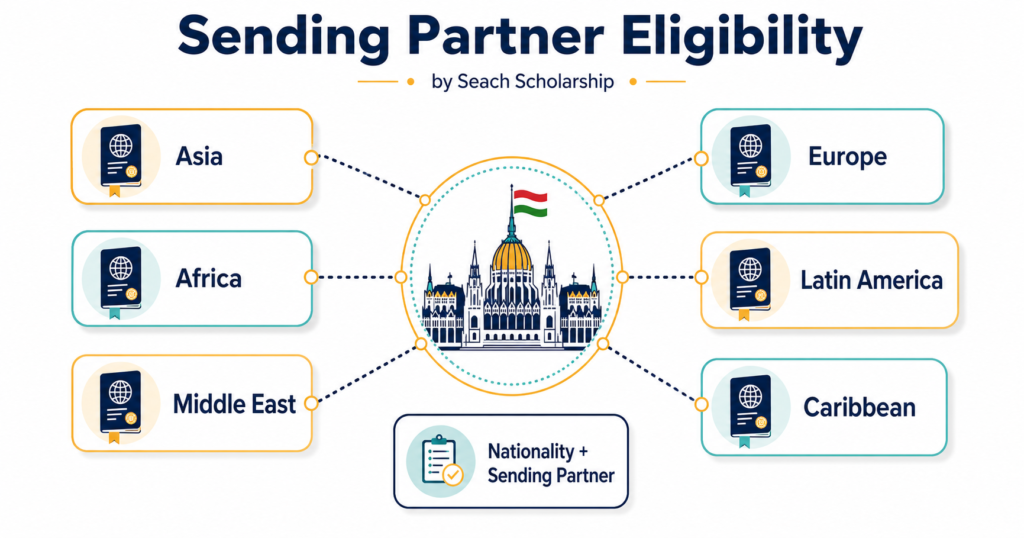
Eligibility is based primarily on the applicant’s nationality and Sending Partner, not simply where the applicant currently lives.
The official partner system currently includes the following countries, territories and partner arrangements:
Europe and neighbouring regions:
Albania, Armenia, Azerbaijan, Belarus, Bosnia and Herzegovina, Georgia, Kosovo, Moldova, Montenegro, North Macedonia, Republic of Srpska, Russia, Serbia, Türkiye and Ukraine.
Asia:
Bangladesh, Brunei, Cambodia, China, India, Indonesia, Japan, Kazakhstan, Kyrgyzstan, Lao People’s Democratic Republic, Malaysia, Maldives, Marshall Islands, Mongolia, Pakistan, Philippines, Singapore, South Korea, Sri Lanka, Taiwan, Tajikistan, Thailand, Turkmenistan, Uzbekistan and Vietnam.
Middle East:
Bahrain, Iran, Iraq, Israel, Jordan, Kurdistan Region, Lebanon, Oman, Palestine, Syria, United Arab Emirates and Yemen.
Africa:
Algeria, Angola, Botswana, Burkina Faso, Burundi, Cape Verde, Chad, Democratic Republic of the Congo, Egypt, Equatorial Guinea, Eritrea, Ethiopia, Gambia, Ghana, Guinea-Bissau, Kenya, Liberia, Libya, Madagascar, Mali, Mauritius, Morocco, Mozambique, Namibia, Nigeria, Rwanda, São Tomé and Príncipe, Seychelles, Sierra Leone, South Africa, Sudan, Tanzania, Tunisia and Uganda.
Latin America and the Caribbean:
Argentina, Belize, Brazil, Chile, Colombia, Costa Rica, Cuba, Dominican Republic, Ecuador, El Salvador, Honduras, Mexico, Panama, Peru, Saint Lucia, Uruguay and Venezuela.
The programme also operates through broader arrangements including the Pacific Alliance, covering Chile, Colombia, Mexico and Peru, and SEGIB, whose eligible participating states include Argentina, Bolivia, Brazil, Chile, Colombia, Costa Rica, Cuba, Dominican Republic, Ecuador, El Salvador, Honduras, Mexico, Panama, Paraguay, Peru, Uruguay and Venezuela.
The current official partner directory contains the complete country and framework list.
Important: Country Eligibility Does Not Mean Every Degree Is Available
Being listed as a Stipendium Hungaricum partner does not automatically mean that you can apply for every degree level or subject.
Each bilateral agreement determines:
- Available degree levels
- Eligible subject areas
- Full-degree or exchange availability
- Sending Partner requirements
- National nomination procedures
For example, the current partner information shows that Albania has Bachelor’s and Master’s study routes across broad fields, while Algeria’s current arrangement does not provide a full-degree Bachelor’s option but does include Master’s opportunities in specified academic areas.
Always select your country in the official Sending Partners database before choosing a university.
Bachelor scholarship route
Stipendium Hungaricum Bachelor Scholarship
The Stipendium Hungaricum Bachelor Scholarship is designed for applicants seeking their first university degree in Hungary.
Bachelor’s programmes included in the programme generally last approximately two to four years, depending on the academic field.
Bachelor Scholarship Benefits
Eligible Bachelor’s scholarship holders receive:
- Tuition support for the approved programme
- HUF 43,700 monthly living contribution
- Dormitory accommodation or eligible housing support
- Healthcare coverage
- Access to the academic and student services offered by their host university
The financial provisions are generally available throughout the normal funded duration of the programme.
Bachelor Eligibility
A Bachelor’s applicant normally needs to:
- Be a citizen of an eligible Sending Partner country or territory
- Apply through the correct country framework
- Choose a Bachelor’s programme permitted for that Sending Partner
- Have completed, or be completing, secondary education that gives access to university
- Meet the language requirements of the selected programme
- Meet any programme-specific academic requirements
- Complete both the Stipendium Hungaricum and Sending Partner procedures where applicable
- Pass the university’s admission assessment
For the 2026/27 standard call, applicants generally had to be at least 18 years old by 31 August 2026, with an exception applying to Dance programmes. Applicants with Hungarian citizenship, including Hungarian dual citizenship, were generally excluded under the standard programme rules.
Future applicants should check the new call because the date used for the age condition changes with each admission cycle.
Academic Qualification for Bachelor’s Applicants
Applicants normally need a secondary-school graduation certificate or another qualification recognised as suitable for entry into the chosen Hungarian Bachelor’s programme.
Students who have not yet graduated when applying may sometimes be allowed to complete the application with the required declaration and submit the final qualification later, subject to the rules of that application year.
A university may also examine subject preparation.
For example, an Engineering or Computer Science programme may expect a suitable background in mathematics, while some health or science programmes may require knowledge of biology, chemistry or physics.
Bachelor Entrance Examination
Receiving nomination from your country does not guarantee admission.
The Hungarian host university performs its own academic assessment.
Depending on the programme, this may involve:
- Online interview
- Written examination
- Mathematics assessment
- Subject-specific examination
- Portfolio
- English-language interview
- Review of previous academic performance
Applicants need to satisfy both the scholarship process and the university’s admission standard.
Master’s and programme options
Stipendium Hungaricum Master Scholarship
The Stipendium Hungaricum Master Scholarship supports eligible students who already have, or are completing, a Bachelor’s degree and want to continue their studies in Hungary.
Standard Master’s programmes under the current programme structure generally last one to two years.
Master Scholarship Benefits
Master’s students generally receive the same principal scholarship provisions as Bachelor’s students:
- Tuition costs for the approved programme
- HUF 43,700 monthly stipend
- Dormitory placement or applicable housing contribution
- Healthcare support
The scholarship is normally provided for the official duration of the approved programme.
Master Eligibility
A Master’s applicant generally needs to:
- Hold citizenship of an eligible Sending Partner
- Choose a Master’s programme permitted under that partner agreement
- Hold an appropriate Bachelor’s qualification or equivalent
- Meet the academic background required by the Hungarian university
- Meet the language requirement
- Complete required application documents
- Receive nomination where the Sending Partner system requires it
- Pass the host university’s admission process
A Bachelor’s degree alone does not guarantee eligibility for every Master’s programme.
Universities can examine whether the subjects and credits completed during your previous studies provide sufficient preparation for the selected graduate programme.
For example, an applicant with a Bachelor’s degree in Computer Science may fit many Computer Science or Software Engineering programmes, while admission to an unrelated specialised Master’s programme may depend on prerequisite courses.
Can Final-Year Bachelor Students Apply?
Depending on the rules of the relevant application cycle, students completing their final Bachelor’s semester may be able to apply before receiving the final degree certificate.
For the 2026/27 call, certain missing final academic documents could be submitted later when the applicant could not reasonably obtain them by the original application deadline, provided the required declaration was submitted on time.
Applicants using this route must follow the exact missing-document procedure for their application year.
One-Tier Master’s Programmes
Hungary also has one-tier Master’s programmes.
These degrees combine Bachelor’s and Master’s-level study into one continuous programme and generally last around five to six years.
They are common in fields where professional education is traditionally delivered as one long programme.
Examples may include:
- Medicine
- Dentistry
- Pharmacy
- Veterinary medicine
- Architecture
- Law
- Certain specialised engineering areas
Applicants usually enter these programmes after secondary school rather than after completing a separate Bachelor’s degree.
Eligibility again depends on the Sending Partner agreement.
Available Universities and Study Programmes
The Stipendium Hungaricum Scholarship includes a large selection of Hungarian higher-education institutions.
The programme’s Study Finder shows hundreds of study options, with many courses offered in English as well as programmes in Hungarian and selected other languages.
Applicants should not start by choosing a university from a random internet list.
Instead:
- Check your Sending Partner.
- Confirm the degree levels available to your country.
- Check the eligible study fields.
- Open the programme database.
- Compare the admission requirements of suitable programmes.
The online application system allows applicants to select up to two study programmes, arranged by preference, under the applicable rules.
Your first preference should therefore be chosen carefully.
Documents and application guides
Documents Required for Stipendium Hungaricum Scholarship
The exact document list depends on your degree, university and programme.
For Bachelor’s and Master’s applicants, common central documents include:
- Online application information
- Recent photograph
- Motivation letter
- Language proficiency evidence
- Previous academic certificate
- Academic transcript
- Passport or eligible identification document
- Online acceptance of the required application statement
- Translations where required
- Programme-specific additional documents
Art and Music programmes may also request portfolios or other supporting material.
The official 2026/27 application materials identify the motivation letter, academic qualification documents, transcripts, language evidence and identification among the standard application components.
Motivation Letter for Stipendium Hungaricum
The motivation letter is an important standard component of the Stipendium Hungaricum Bachelor’s and Master’s application.
For the 2026/27 round, applicants were required to provide at least one page, with the letter prepared in the language of their selected programme or in Hungarian.
The purpose of the motivation letter is to help evaluators understand the reasoning behind the application.
It should connect areas such as:
- Academic background
- Interest in the chosen field
- Reasons for selecting the programme
- Reasons for studying in Hungary
- Relevant achievements or experience
- Future academic or career direction
- Expected value of the scholarship
The letter should be specific to the applicant rather than filled with generic statements about Hungary being a beautiful country or the university being prestigious.
Applicants who need detailed assistance with structure, examples and writing strategy can use a separate Motivation Letter Guide.
CV or Resume for Stipendium Hungaricum
A CV is not listed as a universal central compulsory document for every Bachelor’s and Master’s applicant in the current standard document checklist.
However, individual universities or study programmes may ask applicants for additional materials.
Where a CV is requested, its purpose is to give the university a quick overview of the applicant’s academic and relevant professional profile.
It may include:
- Education
- Relevant experience
- Internships
- Research
- Projects
- Academic awards
- Technical skills
- Language skills
- Volunteering
- Publications or conferences where applicable
The CV should support the application rather than repeat long paragraphs already provided in the motivation letter.
Applicants who need help preparing this document can follow a dedicated Academic CV or Scholarship CV Guide rather than turning the scholarship application itself into a CV-writing exercise.
Recommendation Letter for Stipendium Hungaricum
A common misunderstanding is that every Stipendium Hungaricum Bachelor’s or Master’s applicant must provide a recommendation letter.
That is not currently the general rule.
For the 2026/27 application guide, recommendation letters were not universally compulsory for Bachelor’s, Master’s, one-tier Master’s or non-degree applicants, although individual study programmes can require them in special cases. Applicants can also provide relevant recommendation material as additional documentation when appropriate.
This makes it important to check the requirements of each selected programme.
Where a recommendation is requested, it should normally come from someone who knows the applicant’s academic or professional abilities well.
Suitable recommenders may include:
- University lecturer
- Professor
- Research supervisor
- Thesis supervisor
- Academic adviser
- Relevant professional supervisor where accepted
A useful recommendation should provide evidence of the applicant’s ability rather than simply saying that the applicant is hardworking.
Applicants can consult a separate Recommendation Letter Guide for detailed structure and examples.
Statement of Purpose for Stipendium Hungaricum
A Statement of Purpose, or SOP, is not listed as a separate universal compulsory document in the central 2026/27 Bachelor’s and Master’s document checklist. The standard scholarship application instead requires a motivation letter.
However, individual universities and programmes can have their own additional admission requirements.
If a selected programme asks for a Statement of Purpose, applicants should treat it as a separate academic document rather than automatically submitting a duplicate copy of the motivation letter.
An SOP normally concentrates more strongly on:
- Academic development
- Subject preparation
- Research or project experience
- Specific academic interests
- Programme suitability
- Future academic and professional plans
Applicants should always follow the wording used by the host university.
If it asks for a motivation letter, provide a motivation letter. If it separately requests an SOP, prepare the SOP according to those instructions.
For detailed help, applicants can use a separate Statement of Purpose Guide.
Stipendium Hungaricum Application Fee and Admission Fee Waiver
The standard Stipendium Hungaricum Scholarship application itself is free.
The programme’s official FAQ states that applicants are not charged for online registration/application or participation in the admission examinations conducted within the scholarship process.
This means applicants normally do not need to prepare a separate admission fee waiver request for the standard Stipendium Hungaricum application.
There is already no application charge for these stages of the programme.
Applicants should be cautious if an unofficial agency asks them to pay money simply to submit a Stipendium Hungaricum application.
The programme works through Tempus Public Foundation, participating Hungarian institutions and recognised Sending Partners.
If a university or another organisation requests a payment that seems inconsistent with the scholarship procedure, applicants should verify the charge with the university’s official Stipendium Hungaricum coordinator before paying.
Applicants looking at other universities or scholarships where fees are charged can use a separate Application Fee Waiver Guide to understand how fee-waiver requests normally work.
English Language Requirements
There is no single IELTS or TOEFL score that applies to every Stipendium Hungaricum programme.
Language requirements are generally set by the individual host institution and study programme.
Depending on the programme, universities may accept:
- IELTS
- TOEFL
- Cambridge qualifications
- Other recognised language tests
- Previous education completed in English
- A university-issued Medium of Instruction certificate
- Their own interview or language assessment
The selected university determines the minimum acceptable proficiency level.
Applicants should therefore avoid relying on statements such as “IELTS 6.5 is required for Stipendium Hungaricum” without checking the actual programme.
One university may accept a Medium of Instruction certificate while another may require a formal test.
The Sending Partner can also impose additional national requirements.
Get Your Free Guide Now
Enter your details and we'll send the complete step-by-step guide straight to your inbox.
Application process
How to Apply for Stipendium Hungaricum Scholarship
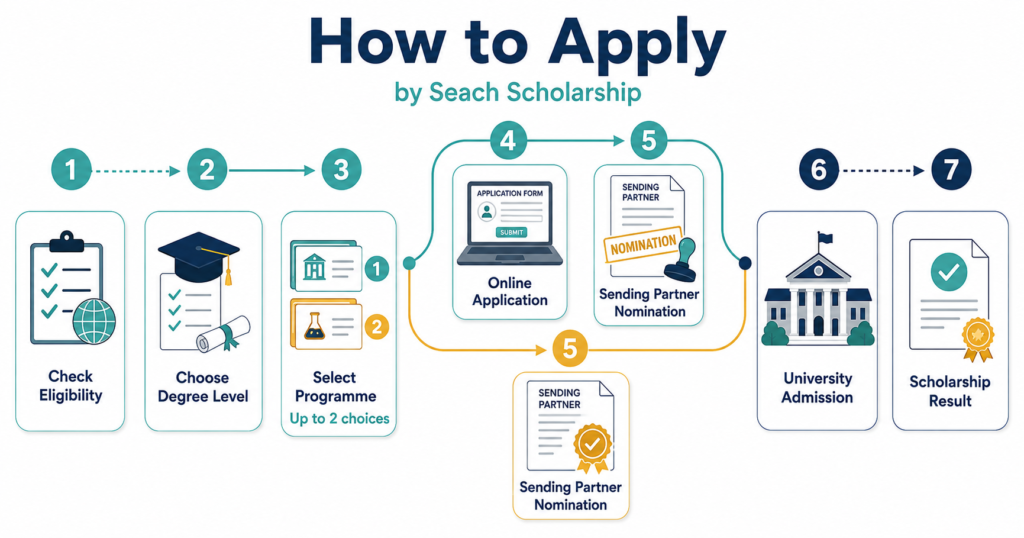
Step 1: Check Your Country
Open the official Sending Partners information and confirm that your nationality participates.
Step 2: Check Your Degree Level
Confirm whether Bachelor’s, Master’s, one-tier Master’s or your preferred study level is offered to applicants from your country.
Step 3: Check Eligible Fields
Do not assume that every field is available.
Your Sending Partner agreement determines which academic areas you may select.
Step 4: Select Your Programmes
Search eligible Hungarian programmes and compare admission requirements.
Applicants can normally select up to two programmes within the permitted application structure.
Step 5: Review Your Sending Partner Procedure
Some countries require a separate national submission or nomination process.
The national deadline may also differ from the Tempus Public Foundation deadline.
Step 6: Prepare the Documents
Collect academic certificates, transcripts, identification, language evidence, motivation letter and any programme-specific documents.
Step 7: Complete the Online Application
Register in the official Stipendium Hungaricum application system and complete every required section.
Saving an incomplete application is not the same as submitting it.
Step 8: Complete the Sending Partner Application
If your country has a separate national application procedure, complete it within the national deadline as well.
Step 9: Wait for Nomination
Applications that satisfy the initial requirements move into the Sending Partner nomination stage where applicable.
Step 10: Complete University Admission
Nominated candidates may then be evaluated by their selected Hungarian university.
An entrance examination or interview may be required.
Step 11: Wait for the Scholarship Decision
Admission to the university and final scholarship allocation are separate parts of the overall process.
Applicants are informed of the scholarship outcome through the official system.
Sending Partner, selection and deadlines
What Is a Sending Partner?
A Sending Partner is the authority or organisation participating in the scholarship arrangement with Hungary.
Depending on the country, this may be:
- Ministry of Education
- Higher Education Commission
- Scholarship authority
- Government department
- Embassy
- National education agency
- Partner organisation
The Sending Partner may have additional requirements beyond the central Hungarian application.
These can include:
- Separate application portal
- Different deadline
- Document submission
- Academic merit requirements
- National testing
- Interview
- Nomination procedure
- Priority study fields
The official programme specifically advises applicants to check their Sending Partner because procedures differ by country.
Stipendium Hungaricum Selection Process
The selection process generally contains several stages.
1. Technical Check
The application is first checked to confirm basic conditions such as nationality, eligibility, required documents and valid programme selection.
2. Sending Partner Nomination
Where the standard partner system applies, the relevant Sending Partner decides which candidates it will nominate.
Only nominated candidates normally continue to the institutional assessment stage.
3. University Evaluation
The Hungarian university evaluates nominated applicants.
This may involve an interview, entrance test or other academic assessment.
4. Allocation
Applicants who pass university admission are considered during the scholarship allocation process.
Factors can include:
- Academic evaluation
- Available scholarship places
- Sending Partner arrangements
- University capacity
- Programme preference order
- Entrance examination results
Passing the university examination does not automatically mean that the scholarship has been awarded.
5. Final Decision
Successful candidates receive their final scholarship result through the official application system.
Stipendium Hungaricum Deadline
For the 2026/27 academic year, the central deadline was:
15 January 2026 at 2:00 PM Central European Time.
That application round is already closed.
Applicants preparing for the next intake should wait for the next official call before publishing or relying on a new deadline.
Historically, preparation and applications take place several months before studies begin, so it is sensible to prepare academic documents, passport, language evidence and written application materials in advance.
However, previous dates should never be presented as confirmed dates for a future round.
Can Pakistani Students Apply for Stipendium Hungaricum?
Yes.
Pakistan is currently listed as a Sending Partner for Stipendium Hungaricum Scholarship.
Pakistani applicants must follow both the Hungarian application process and the applicable Pakistani nomination procedure for the relevant intake.
Students should check the current Pakistani Sending Partner instructions each year because local eligibility criteria, available degree levels, priority fields and nomination requirements may change.
Simply submitting the Hungarian online application does not mean that the applicant has automatically completed every requirement applicable to Pakistan.
Application mistakes
Common Stipendium Hungaricum Application Mistakes
Applicants should avoid:
- Applying without checking country eligibility.
- Choosing a study field not available to their Sending Partner.
- Missing the separate Sending Partner deadline.
- Assuming all countries have identical Bachelor’s and Master’s options.
- Submitting a generic motivation letter.
- Treating the motivation letter and SOP as automatically interchangeable.
- Assuming recommendation letters are compulsory for every Bachelor’s or Master’s application.
- Paying unofficial agents to submit the application.
- Assuming IELTS is required for every programme.
- Ignoring university-specific entrance requirements.
- Selecting two programmes without considering their preference order.
- Uploading unclear or incomplete academic documents.
- Leaving document preparation until the final application day.
- Using previous-year requirements without checking the new call.
- Assuming the monthly scholarship amount will cover every living expense.
Frequently asked questions
Frequently Asked Questions
Is Stipendium Hungaricum fully funded?
The scholarship provides major financial support including tuition coverage, a monthly stipend, accommodation assistance and healthcare support.
However, the programme itself warns that these provisions may not meet every living expense.
How much is the monthly stipend for Bachelor’s students?
Under the current published funding structure, Bachelor’s students receive HUF 43,700 per month.
How much is the monthly stipend for Master’s students?
Master’s students currently receive HUF 43,700 per month under the standard scholarship provisions.
Is accommodation free?
Students may receive a dormitory place depending on availability or housing support according to programme rules.
The current accommodation contribution is HUF 40,000 per month where applicable.
Does Stipendium Hungaricum pay university tuition?
Yes. Tuition for the approved scholarship programme is covered during the eligible scholarship period.
Can Bachelor’s students apply?
Yes, but Bachelor’s availability depends on the applicant’s Sending Partner.
Some countries have Bachelor’s opportunities while others may not.
Can Master’s students apply?
Yes. Master’s programmes are available to applicants from many Sending Partners, subject to country-specific fields and university requirements.
Can I apply for two programmes?
The current application structure allows applicants to choose up to two study programmes and arrange them according to preference.
Do I need IELTS?
Not necessarily.
Language requirements depend on the chosen university and programme.
Check the programme listing before registering for an English test.
Is a motivation letter required?
Yes. A motivation letter is part of the standard Bachelor’s and Master’s application documentation under the current call.
Is a recommendation letter compulsory?
Not generally for all Bachelor’s and Master’s applicants.
Some programmes may specifically request one, so applicants must check their selected programme requirements.
Do I need a Statement of Purpose?
A separate SOP is not listed as a universal central requirement for standard Bachelor’s and Master’s applications in the current call.
A university may nevertheless request additional statements or documents.
Is a CV compulsory?
A CV is not shown as a universal central compulsory document for every standard Bachelor’s or Master’s applicant.
Programme-specific requirements should still be checked.
Is there an application fee?
The standard Stipendium Hungaricum online application and its scholarship admission examinations are free.
Do I need an admission fee waiver?
Normally no, because the standard scholarship application and admission examination process does not charge applicants a fee.
Can Pakistani students apply?
Yes. Pakistan is currently included among the programme’s Sending Partners.
Can I apply if my country is not listed?
Normally, the standard programme requires applicants to be nationals of participating Sending Partner countries or territories.
Living in an eligible country without holding the relevant nationality does not automatically create eligibility.
Can I apply directly to any Hungarian university?
For the scholarship route, you must choose a programme available through the Stipendium Hungaricum system and permitted for your Sending Partner.
Can I apply without nomination?
Under the standard Sending Partner route, nomination is an important selection stage. Candidates who are not nominated generally cannot continue to institutional evaluation for that scholarship cycle.
When will the next Stipendium Hungaricum application open?
The official website currently displays the 2026/27 call. A standard 2027/28 call has not yet been published, so applicants should wait for the next official announcement rather than relying on an estimated date.
Final guidance
Final Thoughts
The Stipendium Hungaricum Scholarship can provide international students with a financially accessible route to a Bachelor’s or Master’s degree in Hungary.
Its application process is different from many scholarships because eligibility does not depend only on university admission. Your nationality, Sending Partner, study level, chosen field, national nomination and host-university assessment can all affect the outcome.
Start by checking your country rather than immediately choosing a university.
Next, confirm whether your country permits Bachelor’s or Master’s study in your intended field. Only then should you select programmes and begin preparing documents.
Pay particular attention to the motivation letter, academic records and university-specific requirements. At the same time, do not unnecessarily prepare documents simply because another applicant used them. A recommendation letter, CV or separate Statement of Purpose may be useful or required in certain cases, but they are not all universal compulsory documents for every Bachelor’s and Master’s applicant.
The standard scholarship application does not require an application-fee waiver because the central application and scholarship admission examination process is already free.
Finally, always check the newest official call before submitting. Country agreements, deadlines, study programmes, document requirements and scholarship rules can change between admission cycles.
Preparing early is useful, but applying with the current official requirements is more important than following an outdated scholarship guide.