
Malaysia International Scholarship Guide | Malaysia
The Malaysia International Scholarship is a Malaysian Government award for academically strong international graduates pursuing full time postgraduate study at selected universities in Malaysia.
It is commonly known as the Malaysia International Scholarship and is administered by Malaysia’s Ministry of Higher Education. Curriculum Vitae
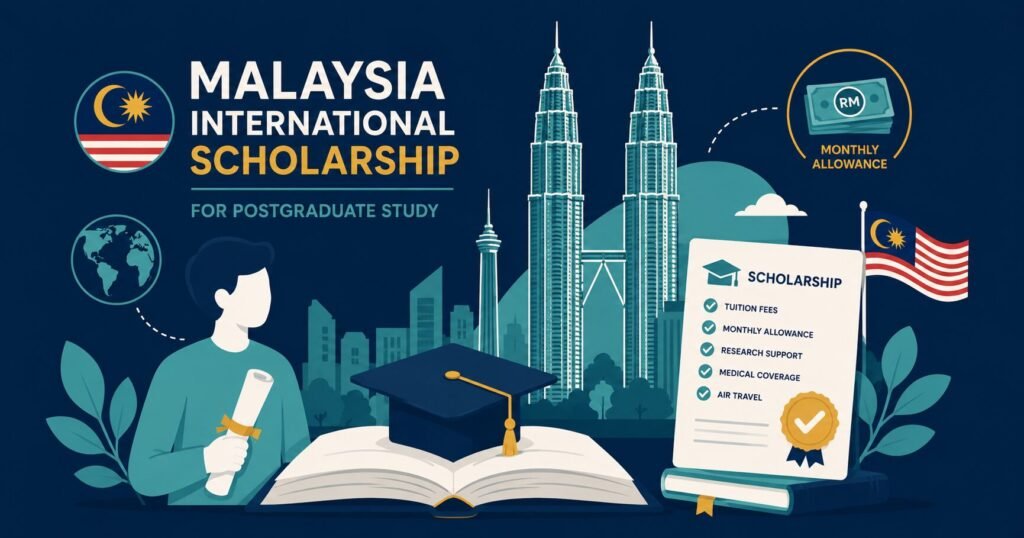
The scholarship supports eligible Master’s and Doctor of Philosophy programmes. It covers tuition fees for the approved sponsorship period and provides a living allowance of RM1,500 per month. The allowance is paid every four months after the scholar submits the required academic progress report.
Malaysia International Scholarship is available to applicants from designated recipient countries. The 2026 eligibility framework included ASEAN countries, Commonwealth countries, and a separate list of countries across Central Asia, East Asia, the Middle East, Africa, Europe, and South America.
Applicants may apply before securing final university admission, but they remain responsible for obtaining admission to an eligible Malaysian institution. Current postgraduate students may also apply when they have at least two semesters remaining in an approved full time programme.
Knowing how to get the Malaysia International Scholarship requires more than meeting the minimum CGPA. Applicants should select an eligible programme, prepare certified documents, demonstrate strong academic and co curricular performance, obtain two detailed recommendations, and submit a high quality research proposal when applying for a research Master’s or PhD.
The application for the 2026 to 2027 academic year is closed. Applicants were able to apply from March 4 to April 3, 2026. The Ministry is currently allowing applicants to check interview shortlisting results from July 7 to July 22, 2026. Dates for the 2027 application cycle have not yet been announced.
This guide explains the scholarship benefits, eligible countries, academic requirements, English tests, supported universities, required documents, research proposal, application process, interviews, and practical ways to strengthen a Malaysia International Scholarship application.
What Is the Malaysia International Scholarship?
The Malaysia International Scholarship is an initiative of the Malaysian Government to attract talented international graduates to leading Malaysian universities and higher education institutions.
The programme supports Malaysia’s goal of developing its higher education system as an international centre for academic excellence and research.
The scholarship is intended for international applicants who want to pursue:
- A full time Master’s degree
- A full time Doctor of Philosophy degree
The award is not available for ordinary Bachelor’s programmes, foundation programmes, diplomas, short courses, exchange semesters, or part time study.
Malaysia International Scholarship is different from the Malaysian Technical Cooperation Programme Scholarship.
Both are Malaysian Government opportunities, but they have different eligibility lists, application systems, funding conditions, and selection procedures.
Applicants should make sure they are reading the guidelines for the Malaysia International Scholarship rather than another Malaysian scholarship.
Latest Application Status
Applications for the Malaysia International Scholarship for the 2026 to 2027 academic year are closed.
The 2026 application period was:
Application opening: March 4, 2026
Application deadline: April 3, 2026
The official Malaysia International Scholarship portal is currently being used for interview shortlisting checks. Applicants can check their status from July 7 to July 22, 2026.
The official opening and deadline for the 2027 cycle have not been published.
Applicants should not assume that April 3 will remain the deadline in 2027.
The Ministry can change:
- Application dates
- Recipient countries
- Supported universities
- Scholarship benefits
- Age requirements
- English language conditions
- Academic requirements
- Required documents
Students preparing for 2027 can use the 2026 guidelines for planning, but they should confirm every condition when the new official document is released.
Who Can Apply?
The 2026 guidelines permitted applications from graduates who were citizens of an eligible recipient country and who met one of the following conditions:
- They intended to begin a full time Master’s or PhD programme in Malaysia.
- They were already completing a full time postgraduate programme at an eligible Malaysian institution and had at least two semesters remaining.
Applicants must also meet the scholarship’s:
- Age requirement
- Academic requirement
- English language requirement
- Country requirement
- Programme requirement
- University requirement
- Document requirements
Research Master’s and PhD applicants must also submit a research proposal of at least 1,000 words.
Meeting the minimum eligibility conditions does not guarantee an interview or scholarship.
Malaysia International Scholarship is competitive and considers academic achievement, extracurricular participation, English communication, and the quality and potential impact of the research proposal.
Eligible Countries
The 2026 scholarship was available to three broad groups.
ASEAN Countries
Eligible ASEAN countries included:
- Brunei Darussalam
- Cambodia
- Indonesia
- Lao PDR
- Myanmar
- Philippines
- Singapore
- Thailand
- Vietnam
Malaysia was not included because Malaysia International Scholarship is intended for international applicants.
Commonwealth Countries
Applicants from Commonwealth countries were included through the Commonwealth Parliamentary Association regions covering Africa, Asia, Australia, the British Islands and Mediterranean, Canada, the Caribbean, the Americas and Atlantic, India, and the Pacific.
Additional Recipient Countries
The separate 2026 recipient list included:
- Afghanistan
- Albania
- Algeria
- Azerbaijan
- Bahrain
- Brazil
- Chile
- China
- Egypt
- Georgia
- Hong Kong
- Hungary
- Iran
- Iraq
- Japan
- Jordan
- Kazakhstan
- Kosovo
- Kuwait
- Kyrgyzstan
- Libya
- Morocco
- Palestine
- Qatar
- Russia
- Saudi Arabia
- Senegal
- Serbia
- South Korea
- Sudan
- Syria
- Tajikistan
- Timor Leste
- Tunisia
- Türkiye
- Turkmenistan
- United Arab Emirates
- Uzbekistan
- Yemen
The country list can change between application cycles.
Applicants must confirm that their nationality appears directly or through an eligible regional category in the guidelines for their application year.
Eligibility for South Asian Countries
The 2026 recipient categories included several South Asian countries through either the Commonwealth category or the separate country list.
Countries Included Through the Commonwealth
The official Commonwealth membership list includes:
- Bangladesh
- India
- Maldives
- Pakistan
- Sri Lanka
Applicants from these countries were therefore covered by the scholarship’s Commonwealth country category in the 2026 Malaysia International Scholarship guidelines.
Afghanistan
Afghanistan was named separately in the 2026 recipient list.
Nepal and Bhutan
Nepal and Bhutan were not individually named in the 2026 Malaysia International Scholarship list and are not Commonwealth member countries.
Applicants from these countries should not assume eligibility unless they are specifically included in the 2027 guidelines.
Country eligibility must be checked each year.
Eligibility for Central Asian Countries
The 2026 recipient list included several Central Asian countries:
- Kazakhstan
- Kyrgyzstan
- Tajikistan
- Turkmenistan
- Uzbekistan
Applicants from these countries could apply when they met all other scholarship requirements.
A Central Asian applicant should still check the new annual guidelines because inclusion in one cycle does not guarantee permanent eligibility.
Can Applicants From African Countries Apply?
Yes.
The 2026 guidelines included Commonwealth countries across Africa and separately named countries such as Algeria, Egypt, Libya, Morocco, Senegal, Sudan, and Tunisia.
Applicants from Commonwealth African countries could qualify through the Commonwealth category.
Other African applicants should check whether their country appears in the separate annual list.
Can Applicants From Europe Apply?
Certain European and nearby countries were included in the 2026 recipient list.
Examples included:
- Albania
- Azerbaijan
- Georgia
- Hungary
- Kosovo
- Russia
- Serbia
- Türkiye
The scholarship was not presented as automatically open to every European nationality.
Can Current Students in Malaysia Apply?
Yes.
International students already enrolled in a full time postgraduate programme at an eligible Malaysian institution could apply when they had at least two semesters remaining before completion.
A current student should prepare:
- A university admission letter
- Current academic records
- Evidence of the remaining study period
- Academic progress information
- All other required Malaysia International Scholarship documents
A student with fewer than two semesters remaining would not satisfy the published 2026 condition.
Eligible Degree Levels
Malaysia International Scholarship supports:
- Master’s degrees
- Doctor of Philosophy degrees
Study must be full time.
The scholarship can support:
- Master’s by coursework
- Master’s by research
- Mixed mode Master’s programmes
- PhD programmes
The precise programme structure depends on the university.
Research Master’s and PhD applicants must submit a research proposal of at least 1,000 words. Applicants to coursework Master’s programmes were not included in that specific proposal requirement.
Does Malaysia International Scholarship Fund Bachelor’s Degrees?
No.
The scholarship supports postgraduate education at Master’s and PhD levels only.
Students looking for undergraduate support should explore university merit scholarships, government agreements, private awards, or other Malaysian international funding programmes.
Does Malaysia International Scholarship Fund Part Time Study?
No.
The scholarship is restricted to full time postgraduate study.
An applicant planning to continue full time employment while studying part time would not meet the standard programme condition.
Supported Universities
The 2026 Malaysia International Scholarship guidelines listed 24 supported institutions, including 20 public universities and four selected private universities.
Public Universities
- Universiti Teknologi Malaysia
- Universiti Sains Malaysia
- Universiti Putra Malaysia
- Universiti Malaya
- Universiti Teknologi Mara
- International Islamic University Malaysia
- Universiti Utara Malaysia
- Universiti Kebangsaan Malaysia
- Universiti Tun Hussein Onn Malaysia
- Universiti Teknikal Malaysia Melaka
- Universiti Sains Islam Malaysia
- Universiti Pendidikan Sultan Idris
- Universiti Malaysia Terengganu
- Universiti Malaysia Sabah
- Universiti Malaysia Pahang
- Universiti Malaysia Sarawak
- Universiti Malaysia Perlis
- Universiti Sultan Zainal Abidin
- Universiti Pertahanan Nasional Malaysia
- Universiti Malaysia Kelantan
Selected Private Universities
- Universiti Teknologi Petronas
- Universiti Tenaga Nasional
- Multimedia University
- INCEIF University
The supported institution list may change for 2027.
Applicants should confirm that both the university and intended programme are included before paying an admission application fee.
How to Choose a University
Do not choose a university only because it is well known.
Compare:
- Programme curriculum
- Research facilities
- Supervisor expertise
- Programme structure
- Tuition fee
- Research output
- English language conditions
- Admission deadline
- Location
- Programme duration
- Graduate outcomes
- Availability of a relevant research supervisor
PhD and research Master’s applicants should review faculty profiles before applying.
A strong Malaysia International Scholarship application should demonstrate that the selected university is suitable for the applicant’s academic and research plans.
Eligible Fields of Study
Applicants could apply for accredited programmes, with priority given to the following areas:
- Education
- Arts and humanities
- Social sciences, journalism and information
- Business, administration and law
- Natural sciences, mathematics and statistics
- Information and communication technologies
- Engineering, manufacturing and construction
- Agriculture, forestry, fisheries and veterinary studies
- Health and welfare, excluding medicine, nursing and pharmacy
The wording of the guidelines indicates that accredited courses outside these priority fields may still be considered.
However, applicants in priority areas may align more closely with the scholarship’s stated objectives.
Are Medicine and Nursing Eligible?
The priority area of health and welfare specifically excludes:
- Medicine
- Nursing
- Pharmacy
Applicants should not assume that every health related postgraduate programme is eligible.
Public health, health management, biomedical research, nutrition, occupational health, or other non clinical subjects may be relevant, but the exact programme should be confirmed before applying.
Scholarship Benefits
The Malaysia International Scholarship provides two principal benefits.
Full Tuition Fees
Tuition fees for the entire approved sponsorship period are paid directly to the university after the university issues an invoice to the Ministry of Higher Education.
The tuition payment is not given to the student as personal cash.
Monthly Living Allowance
Scholars receive RM1,500 per month.
The allowance is paid every four months after submission of the scholar’s progress report to the Ministry.
This means the payment may arrive as a four month amount rather than as an individual payment every month.
Scholars should manage the allowance carefully and prepare funds for expenses that arise before the first payment.
Is the Malaysia International Scholarship Fully Funded?
Malaysia International Scholarship covers full tuition and provides a living allowance, but it should not automatically be described as covering every cost of studying abroad.
The scholarship does not list airfare, accommodation, visa charges, medical examination costs, insurance, relocation expenses, or family support as standard benefits.
Successful applicants are responsible for meeting visa and medical examination requirements. The scholarship offer does not guarantee that a visa will be issued.
A more accurate description is:
A Malaysian Government postgraduate scholarship covering full tuition and an RM1,500 monthly living allowance.
Whether this is sufficient depends on:
- The university location
- Accommodation costs
- Personal lifestyle
- Visa expenses
- Insurance requirements
- International travel costs
- Family responsibilities
- Programme related expenses
Applicants should create a complete budget rather than assuming the scholarship pays every cost.
Does MIS Cover Airfare?
International travel is not included among the benefits in the 2026 guidelines.
Applicants should prepare to pay for:
- Travel to Malaysia
- Return travel
- Baggage
- Airport transportation
- Transit visas where required
- Any travel connected with visa processing
Do not purchase a ticket until admission, scholarship, and visa requirements have been completed.
Does Malaysia International Scholarship Provide Accommodation?
Free university accommodation is not listed as a standard Malaysia International Scholarship benefit.
The RM1,500 monthly allowance can contribute towards housing and living expenses, but the student must arrange accommodation through the university or private housing market.
Applicants should research:
- University residential colleges
- Monthly rent
- Security deposit
- Utility charges
- Transportation costs
- Distance from the faculty
Does Malaysia International Scholarship Cover Visa Costs?
The guidelines make successful candidates responsible for obtaining the appropriate entry visa and completing the required medical examination.
The scholarship does not guarantee:
- Student visa approval
- Payment of visa fees
- Payment of medical screening
- Payment of immigration charges
- Payment of insurance costs
Applicants should review the current international student visa requirements after receiving admission and scholarship results.
Age Requirements
For the 2026 cycle:
Master’s Applicants
Applicants could not be more than 40 years old at the time of application.
PhD Applicants
Applicants could not be more than 45 years old at the time of application.
The rule is based on age at the time of application rather than age when the programme ends.
Applicants close to the limit should calculate their age using the requirements published for the new application year.
Academic Requirements
Master’s Applicants
Applicants needed:
- A minimum CGPA of 3.00 at Bachelor’s level
- Second Class Upper Honours or a higher equivalent result
PhD Applicants
Applicants needed:
- A minimum CGPA of 3.00 at Master’s level
- Excellent results in subjects related to the proposed PhD programme
These are minimum eligibility standards.
Selection remains competitive, so stronger academic performance can improve the application.
How to Explain Your GPA
International grading systems differ.
Applicants should provide:
- Full academic transcripts
- Overall CGPA or final result
- Grading scale
- Class ranking where available
- Cohort size
- Academic distinctions
- Merit awards
- Thesis result
The guidelines require an official grading system document when the transcript does not show CGPA, marks, or score percentile information.
For example:
“CGPA 3.50 out of 4.00” is useful.
“CGPA 3.50 out of 4.00, ranked sixth among 95 students” provides stronger context.
Is There a Minimum CGPA?
Yes.
The 2026 minimum was CGPA 3.00 or its recognised equivalent for both Master’s and PhD applicants.
Meeting 3.00 does not guarantee selection.
Applicants are assessed against other eligible candidates and should demonstrate academic and co curricular excellence beyond the minimum.
English Language Requirements
Applicants had three possible methods of demonstrating English proficiency.
IELTS
An overall IELTS score of 6.0 or higher.
TOEFL
A TOEFL paper based score of 550 or higher, or an equivalent score in another TOEFL format.
English Medium Degree
Applicants could submit an official letter from their previous university confirming that English was the medium of instruction for the completed degree.
The declaration must come from the university.
A statement written by the applicant is not sufficient.
Is IELTS Compulsory?
No.
Applicants may use:
- IELTS
- TOEFL
- An official English medium of instruction letter
However, the selected university may impose a separate English requirement.
A university may request a higher IELTS or TOEFL score even when the scholarship itself accepts an English medium letter.
Applicants must satisfy both the scholarship and university admission conditions.
Admission Requirements
Malaysia International Scholarship and university admission are connected but separate.
Applicants apply for the scholarship through the Ministry’s online system.
They remain responsible for obtaining admission to a supported Malaysian university.
An admission letter should be uploaded when:
- The applicant has already secured admission
- The applicant is already studying in Malaysia
Applicants who have not yet received admission may still prepare the MIS application, but they must later satisfy the university’s admission process.
A scholarship offer does not automatically create a university place.
Should You Apply to the University First?
Applying to the university early is usually the safer strategy.
Early admission can:
- Confirm that the programme is suitable
- Demonstrate that the applicant meets academic requirements
- Provide an admission letter for the Malaysia International Scholarship application
- Allow more time for supervisor discussions
- Reduce delays after scholarship selection
- Support the visa application process
Applicants should compare the university admission deadline with the Malaysia International Scholarship application deadline.
Documents Required
The 2026 Malaysia International Scholarship application required scanned PDF copies of the following documents.
Passport
A certified copy of the passport showing nationality.
The passport needed at least six months of validity.
Academic Transcripts
Master’s applicants needed their undergraduate transcript.
PhD applicants needed undergraduate and Master’s transcripts.
The transcript needed to show all courses completed during the previous programme.
Grading System Document
Applicants needed an official document explaining the university’s grading system when the transcript did not show CGPA, marks, or score percentile information.
English Proficiency Evidence
Applicants needed:
- IELTS
- TOEFL
- An official English medium of instruction declaration
Recommendation Letters
Two recommendation letters were required.
University Admission Letter
This was required when the applicant had already secured admission or was already undertaking postgraduate study in Malaysia.
Curriculum Vitae
A current academic and professional CV was required.
Research Proposal
A research proposal was required for:
- Master’s by research applicants
- PhD applicants
Translation Requirements
All application documents must be in English.
Documents issued in another language require certified English translations.
Applicants should upload:
- The original document
- The certified English translation
Scans should be complete, readable, correctly oriented, and saved in the requested format.
Curriculum Vitae
The CV should clearly present the applicant’s:
- Education
- Research experience
- Employment
- Internships
- Publications
- Conferences
- Academic awards
- Leadership
- Volunteer activities
- Technical skills
- Language skills
- Professional memberships
Research applicants should place greater emphasis on:
- Thesis work
- Research methods
- Data analysis
- Laboratory skills
- Publications
- Research software
- Academic presentations
Co curricular achievements matter because they are included in the scholarship’s selection criteria.
Recommendation Letters
The application requires letters from two referees.
Suitable referees may include:
- A university professor
- A thesis supervisor
- A research project supervisor
- An academic department head
- A professional manager familiar with the applicant’s academic ability
The strongest referees can provide specific evidence of:
- Academic performance
- Research ability
- English communication
- Independence
- Leadership
- Reliability
- Suitability for postgraduate study
A generic letter containing only praise is unlikely to distinguish the applicant.
What a Strong Recommendation Should Include
A useful recommendation should explain:
- How the referee knows the applicant
- How long they have known the applicant
- Which courses, projects, or research they supervised
- The applicant’s performance compared with peers
- Specific examples of research or academic ability
- Why the applicant is ready for postgraduate study
- The applicant’s likely future contribution
Applicants should contact referees early and provide:
- The Malaysia International Scholarship guidelines
- Their CV
- Academic transcript
- Proposed programme
- Research summary
- Submission deadline
Research Proposal Requirements
Research Master’s and PhD applicants must submit a proposal of at least 1,000 words related to the intended field of study.
The selection committee considers:
- The quality of the research proposal
- Its potential contribution to technological advancement
- Its potential contribution to human wellbeing
- Its relevance to Malaysia, with preference given to Malaysia related research topics
A proposal should not be written only to reach the minimum word count.
It should demonstrate that the applicant understands the research problem and can complete the project successfully.
Suggested Research Proposal Structure
A practical proposal can include:
Research Title
Use a clear and specific title.
Background
Explain the wider subject and why the topic matters.
Research Problem
Identify the exact issue the study will address.
Literature Gap
Explain what previous research has not resolved.
Research Questions
Present focused and answerable questions.
Objectives
State what the research will achieve.
Methodology
Explain:
- Research design
- Data sources
- Participants or samples
- Data collection
- Data analysis
- Ethical considerations
Expected Results
Describe the likely academic, technological, policy, or social contribution.
Malaysia Relevance
Explain how the project relates to:
- Malaysian data
- Malaysian institutions
- Malaysian industries
- Malaysian communities
- Malaysia’s development priorities
- Collaboration between Malaysia and the applicant’s country
Timeline
Show how the research can be completed within the degree period.
References
Include credible academic sources using a consistent citation system.
How to Get the Malaysia International Scholarship
To understand how to get the Malaysia International Scholarship, applicants should focus on seven areas.
Confirm Country Eligibility
Check the recipient list for the correct year.
Do not assume that all nationalities are eligible.
Choose an Eligible University
The university must appear on the official Malaysia International Scholarship list.
Select a Strong Programme
The programme should match your previous education and professional direction.
Exceed the Minimum Academic Standard
A CGPA of 3.00 makes an applicant eligible, but stronger results can make the application more competitive.
Prepare Excellent Recommendations
Choose referees who can provide specific academic evidence.
Write a Strong Research Proposal
Research applicants should present a focused project with clear methods, practical value, and a strong connection with Malaysia where appropriate.
Demonstrate Co Curricular Achievement
The scholarship considers both academic and co curricular achievement.
Useful evidence may include:
- Leadership
- Volunteering
- Academic societies
- Professional associations
- Community projects
- Competitions
- Innovation activities
- Entrepreneurship
Step by Step Application Process
Step 1: Check Your Nationality
Confirm that your country is included in the current Malaysia International Scholarship guidelines.
Step 2: Choose the Degree Level
Select either:
- Master’s
- PhD
Make sure you meet the relevant age and academic requirements.
Step 3: Select a Supported University
Review the 24 institutions included in the current guidelines.
Step 4: Choose an Eligible Programme
Check the programme’s:
- Entry requirements
- Tuition
- Duration
- Research structure
- English conditions
- Admission deadline
Step 5: Apply for University Admission
Complete the university’s separate postgraduate admission process.
Step 6: Prepare Certified Documents
Collect:
- Passport
- Transcripts
- Grading scale
- English evidence
- Recommendations
- CV
- Admission letter where available
- Research proposal where required
Step 7: Create an Malaysia International Scholarship Account
Use the official Ministry of Higher Education scholarship portal.
Step 8: Complete the Application Form
Enter personal, academic, programme, and contact information accurately.
Step 9: Upload PDF Documents
Check that every file is:
- Complete
- Readable
- Certified where required
- Translated into English where required
- Saved in the accepted format
Step 10: Review the Research Proposal
Make sure it meets the minimum 1,000 word requirement when applicable.
Step 11: Submit Before the Deadline
Do not wait until the final day.
Step 12: Monitor the Portal and Email
Shortlisted applicants may be invited to an interview.
Step 13: Complete University and Visa Requirements
Selected scholars must obtain admission, a student visa, and the required medical clearance.
How Applicants Are Selected
The 2026 guidelines identified three principal selection areas.
Academic and Co Curricular Achievement
The committee looks for outstanding performance in education and activities beyond the classroom.
Research Proposal
Research applicants are assessed on the quality and potential contribution of their proposal.
Preference may be given to Malaysia related research topics.
English Communication
Applicants should demonstrate excellent speaking, writing, and reading ability in English.
The current application process also includes interview shortlisting, meaning selected applicants may be asked to discuss their background and plans before a final decision.
Malaysia International Scholarship Interview Preparation
Applicants invited to an interview should prepare to explain:
- Why they selected Malaysia
- Why they selected the university
- Why the programme fits their background
- Their strongest academic achievements
- Their co curricular contributions
- Their research topic
- Their proposed methodology
- How the research relates to Malaysia
- Their career plans
- How the degree may benefit their country or field
Research Interview Questions
Research applicants may be asked:
- What problem does your research address?
- What is original about the project?
- Why should the research be conducted in Malaysia?
- Which methods will you use?
- What data will you need?
- Is the project realistic within the degree period?
- How will the research improve human wellbeing or technology?
- Have you identified a supervisor?
The applicant should be able to explain the proposal in simple language rather than memorising technical paragraphs.
How to Improve Your Chances
Apply to the University Early
An admission letter can strengthen the practical readiness of the application.
Provide Academic Context
Include ranking, cohort size, distinctions, and grading system information.
Choose Relevant Referees
Academic referees are particularly valuable for research programmes.
Connect the Proposal With Malaysia
A credible Malaysia related research element can align with the stated selection preference.
Demonstrate Co Curricular Achievement
Use evidence rather than listing memberships without explanation.
Prepare a Professional CV
Prioritise relevant academic, research, leadership, and professional experience.
Use Strong English
Proofread the application, proposal, CV, and all written responses.
Follow Every Formal Requirement
Certification, translation, passport validity, file format, and document completeness matter.
Prepare for the Interview
Review the entire submitted application before attending.
Build a Complete Financial Plan
Budget for travel, visa, accommodation, medical screening, and costs not covered by the award.
Common Application Mistakes
Applying From an Ineligible Country
Check the annual recipient list.
Applying for a Bachelor’s Degree
Malaysia International Scholarship supports Master’s and PhD study only.
Applying for Part Time Study
Only full time programmes are eligible.
Applying to an Unsupported University
The university must appear on the official list.
Assuming the Scholarship Covers Airfare
Travel is not included in the published benefits.
Assuming Accommodation Is Free
Housing is not listed as a separate benefit.
Missing the Age Requirement
Master’s and PhD applicants have different age limits.
Submitting an Incomplete Transcript
The transcript must show all previous courses.
Omitting the Grading Scale
A separate official explanation is required when the transcript does not explain the grading system.
Using an Unofficial English Medium Letter
The letter must be issued by the previous university.
Submitting Weak Recommendations
Choose referees who know your academic work.
Writing Fewer Than 1,000 Words
The minimum applies to research Master’s and PhD proposals.
Submitting a General Research Topic
The proposal should include a defined problem, methods, outcomes, and relevance.
Ignoring Malaysia Related Research
The selection criteria state a preference for Malaysia related topics.
Depending Entirely on RM1,500
The allowance may not cover all personal expenses.
Missing the University Application
The Malaysia International Scholarship application does not automatically secure admission.
Frequently Asked Questions
What is the Malaysia International Scholarship?
It is a Malaysian Government scholarship for eligible international students pursuing full time Master’s and PhD programmes at selected institutions.
How to get the Malaysia International Scholarship?
Confirm your country and programme eligibility, apply to a supported university, meet the CGPA and English requirements, obtain two recommendations, prepare certified documents, and submit a strong research proposal when applying for a research Master’s or PhD.
Is the Malaysia International Scholarship fully funded?
It covers full tuition and provides RM1,500 per month. Airfare, accommodation, visa expenses, and several other costs are not listed as separate benefits.
How much is the monthly stipend?
The living allowance is RM1,500 per month. It is paid every four months after submission of the required progress report.
Does MIS cover full tuition?
Yes. Tuition for the approved sponsorship period is paid directly to the university.
Does MIS cover airfare?
Airfare is not included in the published 2026 benefits.
Does MIS provide accommodation?
Free accommodation is not listed as a separate benefit.
Does MIS cover visa expenses?
Successful candidates are responsible for meeting visa and medical examination requirements.
Can students from South Asia apply?
Applicants from Afghanistan, Bangladesh, India, Maldives, Pakistan, and Sri Lanka were covered through the 2026 recipient list or Commonwealth category. Nepal and Bhutan were not included through those categories.
Can applicants from Central Asia apply?
Yes. The 2026 list included Kazakhstan, Kyrgyzstan, Tajikistan, Turkmenistan, and Uzbekistan.
Can African students apply?
Yes. Commonwealth African countries and several separately listed African countries were eligible.
Can ASEAN students apply?
Yes. The list included Brunei Darussalam, Cambodia, Indonesia, Lao PDR, Myanmar, Philippines, Singapore, Thailand, and Vietnam.
Does MIS fund Bachelor’s degrees?
No.
Does MIS fund Master’s degrees?
Yes.
Does MIS fund PhD programmes?
Yes.
Does MIS fund part time study?
No. Programmes must be full time.
Can current students in Malaysia apply?
Yes, when studying full time at an eligible institution with at least two semesters remaining.
What is the Master’s age limit?
Applicants could not be more than 40 years old in the 2026 cycle.
What is the PhD age limit?
Applicants could not be more than 45 years old in the 2026 cycle.
What CGPA is required?
The minimum published requirement was CGPA 3.00 or its recognised equivalent.
Is IELTS required?
Applicants can provide IELTS 6.0, TOEFL 550 PBT or an equivalent TOEFL result, or an official English medium of instruction letter.
Is a medium of instruction letter accepted?
Yes, when it is officially issued by the university that awarded the previous degree.
Are recommendation letters required?
Yes. Two recommendation letters are required.
Is a research proposal required?
It is required for Master’s by research and PhD applications.
What is the research proposal word limit?
The proposal must contain at least 1,000 words.
Does the research need to focus on Malaysia?
It is not stated as an absolute requirement, but the selection criteria give preference to Malaysia related research topics.
Is university admission required before applying?
Applicants who have already secured admission should upload the letter. All selected scholars remain responsible for confirming university admission.
Can I apply to a private university?
Only the selected private institutions included in the current MIS list are supported.
Which private universities were eligible in 2026?
Universiti Teknologi Petronas, Universiti Tenaga Nasional, Multimedia University, and INCEIF University were included.
Can medicine students apply?
Medicine is excluded from the priority health and welfare category.
Can nursing students apply?
Nursing is excluded.
Can pharmacy students apply?
Pharmacy is excluded.
Can scholarship recipients work?
Paid employment is not allowed without written approval from the host university.
Can scholars change programmes?
A programme change requires written permission from both the university and the Ministry.
What happens if academic progress is unsatisfactory?
The scholarship can be withdrawn when the scholar fails to maintain satisfactory academic progress and good standing.
When did the 2026 application open?
It opened on March 4, 2026.
What was the 2026 deadline?
The deadline was April 3, 2026.
When will the 2027 application open?
The official 2027 application dates have not yet been announced.
Is there an interview?
The Ministry is currently using an interview shortlisting stage for the 2026 cycle.
Final Thoughts
The Malaysia International Scholarship provides full tuition and an RM1,500 monthly allowance for eligible international students completing full time Master’s and PhD programmes in Malaysia.
It is a valuable scholarship, but applicants should understand that it does not list airfare, accommodation, visa charges, or every living expense as separate benefits.
A competitive applicant should:
- Confirm country eligibility
- Select a supported university
- Choose a suitable postgraduate programme
- Meet the age requirement
- Exceed the minimum academic standard
- Provide valid English language evidence
- Obtain two detailed recommendations
- Prepare certified English documents
- Write a strong research proposal where required
- Demonstrate academic and co curricular excellence
- Explain the value of the proposed study
- Prepare carefully for an interview
The most practical answer to how to get the Malaysia International Scholarship is to create one consistent application.
Your academic background, selected university, proposed programme, research plan, recommendations, extracurricular record, and career goals should all demonstrate that you are ready to succeed in Malaysia and use the qualification meaningfully afterward.
The 2026 to 2027 application is closed. Applicants preparing for 2027 should begin researching universities, contacting potential supervisors, arranging recommendations, and developing their research proposals before the new official application dates are released.