
How to Build a Scholarship Resume / Academic CV
A scholarship resume or academic CV presents your education, achievements, leadership, research, skills, and relevant experience in a clear and organised format.
It helps a scholarship committee understand what you have achieved, how you have used available opportunities, and whether your academic and professional direction matches the purpose of the scholarship.
A strong scholarship CV is not simply a list of everything you have done.
It is a carefully selected record of the experiences that make you a credible candidate for a particular scholarship, degree programme, research opportunity, or academic institution.
Students often make one of two mistakes.
Some provide a very short employment resume that does not explain their academic achievements.
Others submit a long document containing every course, certificate, seminar, and minor activity they have ever completed.
The best scholarship CV sits between these extremes.
It should be focused, evidence based, easy to scan, and tailored to the scholarship.
This guide explains how to build a scholarship CV, which sections to include, how to write strong achievement statements, what scholarship committees look for, how an academic resume differs from a job resume, and how to create a professional document even when you have limited experience.
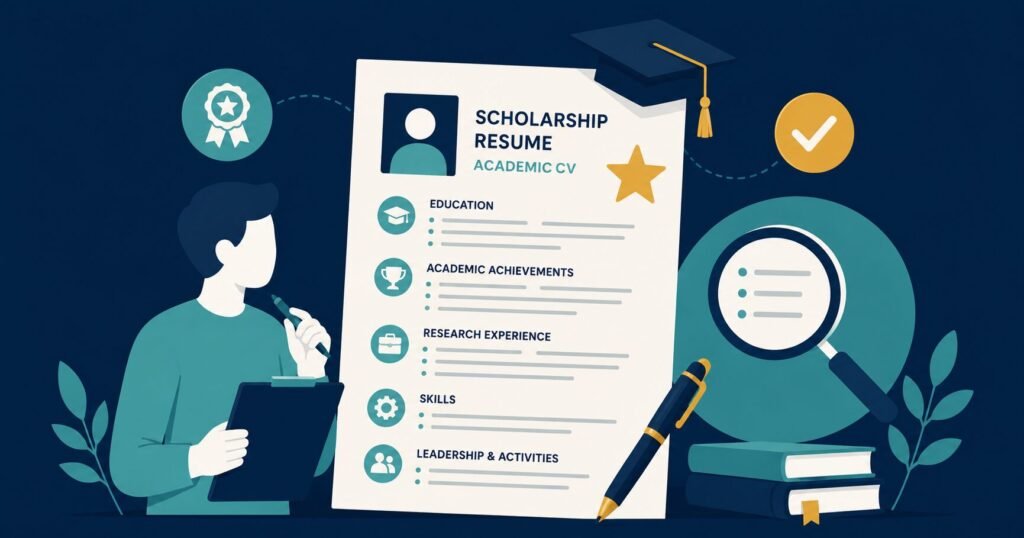
What Is a Scholarship Resume?
A scholarship Resume is a document created specifically for an academic funding application.
It normally highlights:
- Education
- Academic performance
- Research experience
- Awards
- Leadership
- Volunteer work
- Relevant employment
- Internships
- Skills
- Publications
- Conferences
- Professional goals
The document should help the selection committee answer several important questions.
Is the applicant academically prepared?
Has the applicant demonstrated initiative?
Has the applicant contributed to a university, workplace, or community?
Does the applicant have leadership or research potential?
Does the applicant’s background support the proposed degree?
Will the scholarship help the applicant create meaningful future value?
A scholarship CV should provide evidence for these questions without repeating the full motivation letter or statement of purpose.
Scholarship Resume and Academic Resume Difference
The terms scholarship CV and academic resume are often used interchangeably, but they may describe slightly different documents.
A resume is usually short and selective. It often focuses on skills and experience relevant to a particular opportunity.
An academic CV may be more detailed. It can include research, publications, teaching, conferences, awards, academic service, and professional memberships.
For most Bachelor’s and Master’s scholarship applications, a focused one or two page academic resume is usually appropriate.
For a PhD, research fellowship, or academic position, a longer academic CV may be necessary.
The scholarship instructions should determine the final format.
When the application asks for a resume, submit a concise and targeted document.
When it requests a complete academic CV, include a fuller record of research, publications, teaching, and academic activities.
What Scholarship Committees Look For
Scholarship committees do not normally select candidates based on document design alone.
They look for evidence of merit, potential, consistency, and alignment.
A strong CV can demonstrate these qualities through several areas.
Academic Performance
This may include:
- GPA
- Percentage
- Class ranking
- Academic distinction
- Strong grades in relevant subjects
- Thesis result
- Research performance
Leadership
Leadership does not require a senior title.
It may be demonstrated through:
- Managing a student society
- Leading a project
- Coordinating volunteers
- Mentoring students
- Organising an event
- Solving a problem within a team
Community Contribution
Scholarship programmes often value candidates who use their education and skills to support others.
Examples include:
- Teaching students
- Organising awareness campaigns
- Supporting disadvantaged communities
- Participating in environmental projects
- Volunteering with charities
- Developing useful community resources
Academic and Professional Direction
Your Scholarship Resume should show a logical connection between:
- Previous education
- Current experience
- Proposed degree
- Career goals
- Future contribution
A scattered CV can make an applicant appear uncertain.
A focused CV shows that the scholarship is part of a clear academic or professional path.
Recommended Scholarship Resume Length
For most students, the recommended length is one or two pages.
A one page scholarship resume may be sufficient when:
- You are applying for an undergraduate scholarship
- You recently completed secondary school
- You have limited work or research experience
- The scholarship provides a strict page limit
A two page scholarship resume may be better when:
- You are applying for a Master’s scholarship
- You have internships, research, leadership, and volunteer experience
- You need space to include awards and skills
- The application does not impose a one page limit
A longer academic CV may be appropriate when:
- You are applying for a PhD
- You have several publications
- You have teaching experience
- You have completed multiple research projects
- You have presented at conferences
- The scholarship specifically requests a full academic CV
Do not make the document longer simply to appear experienced.
Every section should contribute to the application.
Best Scholarship Resume Format
Use reverse chronological order.
This means listing your most recent education, work, research, or activity first.
A typical structure is:
- Name and contact details
- Academic profile
- Education
- Academic achievements
- Research experience
- Work or internship experience
- Leadership and volunteering
- Awards and scholarships
- Skills
- Languages
- Certifications
- Publications or conferences
The best order depends on your strongest qualifications.
A student with excellent grades but little employment should place education and academic achievements near the top.
An experienced professional applying for a leadership scholarship may place professional experience after the academic profile.
A PhD applicant should normally prioritise education, research, publications, and academic experience.
Contact Information
Place your contact information at the top of the first page.
Include:
- Full name
- Professional email address
- Phone number with country code
- City and country
- LinkedIn profile where relevant
- Academic portfolio or research profile where relevant
- ORCID profile where relevant
Avoid including unnecessary personal details unless the scholarship requests them.
You usually do not need to include:
- National identity number
- Passport number
- Full home address
- Marital status
- Religion
- Salary information
- Names of family members
- Personal social media accounts
Use a professional email address based on your name.
An address such as firstname.lastname@email.com is more suitable than an informal username.
Should You Add a Photo?
A photograph is not required for most international scholarship resumes.
In some countries and application systems, photographs are common. In others, they are discouraged.
Follow the scholarship instructions.
When no photograph is requested, it is usually safer to leave it out and use the space for academic information.
Do not include a photograph simply to make the scholarship resume look attractive.
Academic Profile or Personal Statement
An academic profile is a short paragraph placed near the top of the scholarship resume.
It should normally contain three or four lines.
It can explain:
- Your current academic or professional status
- Your strongest area of experience
- Your intended field of study
- Your main academic or career objective
A good profile is specific and evidence based.
Weak Example
Motivated and hardworking student seeking a scholarship to achieve my dreams and study at a prestigious university.
This statement could describe almost any applicant.
Stronger Example
Environmental science graduate with research experience in water quality monitoring, community fieldwork, and geographic information systems. Ranked among the top ten students in the graduating class and seeking advanced training in environmental management to support evidence based water policy.
The stronger example provides academic direction and evidence.
Education Section
Education is normally one of the most important sections in a scholarship resume.
For each qualification, include:
- Degree or qualification title
- Subject or major
- Institution
- City and country
- Start and completion dates
- GPA, percentage, or grade where strong
- Class ranking where available
- Thesis or final project title where relevant
- Important academic distinctions
Example
Bachelor of Science in Computer Science
National University, Lahore, Pakistan
September 2022 to June 2026
CGPA: 3.78 out of 4.00
Class Rank: 5 out of 112 students
Final Project: Machine Learning Model for Early Flood Risk Detection
Do not list every subject studied unless the scholarship asks for relevant coursework.
For a Master’s or PhD application, you may mention selected courses when they directly support the proposed programme.
Should You Include Secondary School?
Include secondary school when:
- You are applying for a Bachelor’s scholarship
- You have not yet completed university
- Your school results are particularly strong
- The application requests a complete education history
Master’s and PhD applicants can normally remove secondary school information unless it is directly relevant.
Academic Achievements
Create a separate academic achievements section when you have several strong accomplishments.
Examples include:
- Class ranking
- Dean’s list
- Gold medal
- Academic distinction
- Merit certificate
- Best thesis award
- Research competition award
- Subject prize
- University merit scholarship
- Academic competition result
Use dates and measurable details.
Weak Example
Received many academic awards.
Stronger Example
Awarded the Faculty Merit Scholarship for ranking in the top five percent of the class, 2024 and 2025.
Research Experience
Research experience is especially important for Master’s by research, PhD, and fellowship applications.
For each project, include:
- Role
- Institution or department
- Research title
- Dates
- Research methods
- Your contribution
- Results or outputs
- Supervisor where useful
Example
Undergraduate Research Assistant
Department of Public Health, National University
January 2025 to October 2025
- Supported a mixed methods study examining vaccination access in rural communities.
- Conducted 65 structured interviews and prepared anonymised datasets.
- Used SPSS to clean and analyse survey data.
- Contributed to a research poster presented at the National Public Health Conference.
Do not describe only the general research topic.
Explain what you personally did.
Work and Internship Experience
Employment can strengthen a scholarship resume when it demonstrates relevant skills, responsibility, and professional development.
For each role, include:
- Job title
- Organisation
- Location
- Dates
- Main responsibilities
- Achievements
- Results
Focus on work that supports the scholarship application.
Weak Example
Worked as an intern and helped the team with different tasks.
Stronger Example
Prepared monthly performance reports for a five member project team and developed a tracking sheet that reduced reporting errors.
Use action verbs such as:
- Analysed
- Coordinated
- Designed
- Developed
- Improved
- Managed
- Organised
- Presented
- Researched
- Trained
- Supported
- Implemented
- Evaluated
- Led
- Produced
Leadership Experience
Scholarship programmes often ask for evidence of leadership.
A leadership section may include:
- Student society roles
- Team leadership
- Community projects
- Event organisation
- Mentoring
- Entrepreneurship
- Campaign coordination
- Project management
Example
President, Environmental Society
National University
August 2024 to May 2025
- Led a committee of 12 students.
- Organised four campus sustainability events attended by more than 500 participants.
- Coordinated a tree planting partnership with two local schools.
- Secured sponsorship from three local organisations.
Leadership statements should show action and results.
A title without evidence is not enough.
Volunteer and Community Activities
Volunteer work can demonstrate commitment, social responsibility, communication, and initiative.
Include activities that involved meaningful participation.
For each activity, mention:
- Organisation
- Role
- Dates
- Main contribution
- People reached
- Results
Example
Volunteer Mathematics Tutor
Community Learning Centre
March 2023 to December 2024
Provided weekly mathematics support to 20 secondary school students and developed practice materials for examination preparation.
Avoid including a volunteer activity when you attended only once and had no meaningful role.
Publications
A publication section is useful for research applicants.
Include:
- Author names
- Article title
- Journal or publisher
- Year
- Volume and issue where relevant
- DOI or link where appropriate
Separate publications by status.
Possible categories include:
- Published articles
- Accepted articles
- Articles under review
- Book chapters
- Research reports
- Conference proceedings
Do not list a paper as published when it is only being prepared.
Use accurate labels.
Conferences and Presentations
Include:
- Presentation title
- Conference name
- Institution or location
- Date
- Presentation type
Possible presentation types include:
- Oral presentation
- Poster presentation
- Panel contribution
- Workshop
- Invited talk
Example
“Community Based Flood Risk Mapping Using Open Source Data,” poster presented at the National Climate Research Conference, Islamabad, November 2025.
Attending a conference is different from presenting at one.
Use separate wording.
Awards and Scholarships
List competitive awards that demonstrate academic, leadership, professional, or community achievement.
Include:
- Award name
- Awarding organisation
- Year
- Short explanation where the title is unclear
Example
University Merit Scholarship, 2024
Awarded to the highest performing ten percent of undergraduate students.
Do not include every participation certificate.
Prioritise awards with a competitive or achievement based selection process.
Skills Section
Skills should be relevant and specific.
Useful categories include:
Research Skills
- Literature review
- Survey design
- Qualitative interviews
- Statistical analysis
- Laboratory techniques
- Academic writing
- Data collection
Technical Skills
- Python
- R
- SPSS
- Stata
- MATLAB
- Geographic information systems
- AutoCAD
- Adobe Creative Suite
- Microsoft Excel
- Database management
Professional Skills
- Project coordination
- Report writing
- Public speaking
- Stakeholder communication
- Team leadership
- Event management
Avoid rating yourself with vague bars, stars, or percentages.
Instead of writing:
Microsoft Excel: 90 percent
Write:
Microsoft Excel: PivotTables, lookup functions, charts, data cleaning, and basic financial models.
Languages
List languages with an honest proficiency level.
A practical format is:
- Native
- Fluent
- Professional working proficiency
- Intermediate
- Basic
You may also include recognised test results.
Example
English: IELTS Academic 7.5
Urdu: Native
French: Intermediate
Do not claim fluency when you cannot participate comfortably in an interview or academic discussion.
Certifications and Training
Include certifications that are relevant to the scholarship or field.
Examples include:
- Data analysis
- Research ethics
- Project management
- Teaching methods
- Programming
- Public health
- Laboratory safety
- Language training
- Leadership development
- Professional licensing
For each certificate, include:
- Course title
- Provider
- Completion date
- Credential identifier where useful
Avoid listing short online courses that do not strengthen the application.
Extracurricular Activities
Extracurricular activities can show balance, teamwork, creativity, and commitment.
Examples include:
- Debating
- Sports
- Theatre
- Music
- Student journalism
- Academic societies
- Entrepreneurship
- Model United Nations
- Community campaigns
- Cultural organisations
Describe your contribution and any achievement.
Simply writing “Member of debating society” provides limited value.
References
Some scholarship applications request references directly through an online system.
In that case, you do not need to list them in the scholarship resume unless instructed.
When references are requested in the document, include:
- Full name
- Academic or professional title
- Institution
- Email address
- Professional relationship
Ask permission before adding someone’s contact details.
Do not write “References available upon request” unless the scholarship resume template specifically requires it.
The space is usually better used for stronger content.
How to Write Strong Achievement Statements
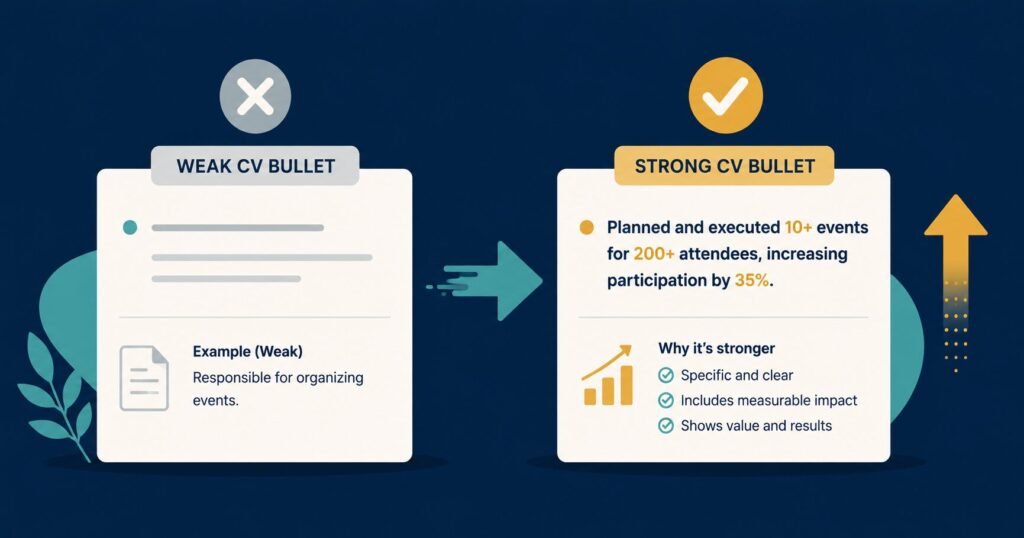
A strong scholarship resume statement normally contains three parts:
- Action
- Task
- Result
A useful formula is:
Action verb + what you did + measurable result or purpose
Weak Statement
Helped organise a student event.
Strong Statement
Coordinated registration and speaker communication for a two day academic conference attended by 350 students.
Weak Statement
Worked on a research project.
Strong Statement
Analysed survey responses from 420 participants using SPSS and prepared visual summaries for the final research report.
Weak Statement
Volunteered with a charity.
Strong Statement
Managed weekly learning sessions for 25 students from low income communities and developed revision materials for secondary school examinations.
Use numbers when they provide meaningful context.
Possible measurements include:
- Number of participants
- Number of students supported
- Amount of funding secured
- Percentage improvement
- Number of reports produced
- Team size
- Project duration
- Number of events
- Research sample size
- Audience size
Do not invent statistics.
How to Build a Scholarship Resume With No Work Experience
Students often believe they have nothing to include because they have not had a formal job.
A scholarship resume can still be strong.
Focus on:
- Education
- Academic results
- School or university projects
- Research assignments
- Volunteer work
- Student societies
- Competitions
- Leadership roles
- Online courses
- Skills
- Sports
- Community service
- Personal projects
- Family business responsibilities
- Independent learning
A final year project can demonstrate research, technical ability, teamwork, and problem solving.
A student society role can demonstrate leadership and communication.
Tutoring younger students can demonstrate service and responsibility.
The value of an experience depends on how clearly you explain it.
How to Tailor the Resume for Each Scholarship
Do not send exactly the same scholarship resume to every scholarship.
Tailoring does not mean changing facts.
It means changing emphasis.
For a leadership scholarship, highlight:
- Team management
- Community initiatives
- Professional responsibility
- Decision making
For a research scholarship, highlight:
- Thesis work
- Publications
- Research methods
- Academic conferences
- Supervisor collaboration
For a development scholarship, highlight:
- Community contribution
- Public service
- Development challenges
- Relevant professional experience
For a technology scholarship, highlight:
- Technical projects
- Programming
- Innovation
- Research
- Competitions
Move the most relevant sections closer to the top.
Scholarship Resume / Academic CV Template
FULL NAME
City, Country
Phone with country code
Professional email address
LinkedIn or academic profile
Academic Profile
Write three or four lines summarising your academic background, strongest achievements, intended field, and future direction.
Education
Degree Title in Subject
University Name, City, Country
Month Year to Month Year
GPA or Grade
Class Rank where available
Thesis or Final Project where relevant
Academic Achievements
- Award or distinction, organisation, year
- Academic ranking or merit scholarship, year
- Competition or research award, year
Research Experience
Research Role
Department or Institution
Month Year to Month Year
- Explain the research topic.
- Describe your methods and responsibilities.
- Include outputs or results.
Professional and Internship Experience
Position Title
Organisation, City, Country
Month Year to Month Year
- Describe your main contribution.
- Include measurable achievements.
- Mention relevant skills.
Leadership Experience
Role
Organisation
Month Year to Month Year
- Explain what you led.
- Include team size, activities, and results.
Volunteer Experience
Role
Organisation
Month Year to Month Year
Describe the community served, activities completed, and results.
Publications and Presentations
Use a consistent academic citation format.
Awards and Scholarships
List the award name, organisation, year, and reason for selection.
Skills
Research:
Technical:
Professional:
Languages
Language and proficiency level
Certifications
Course, provider, year
Scholarship Resume Example
AYESHA KHAN
Moscow, Russia
+92 300 0000000
ayesha.khan@email.com
linkedin.com/in/ayeshakhan
Academic Profile
Economics graduate with strong academic performance and experience in development research, quantitative analysis, and community education. Ranked fourth among 96 students and completed a final year research project on women’s access to digital financial services. Seeking postgraduate training in development economics to support inclusive financial policy.
Education
Bachelor of Science in Economics
National University, Lahore, Pakistan
September 2022 to June 2026
CGPA: 3.82 out of 4.00
Class Rank: 4 out of 96 students
Final Project: Digital Financial Inclusion Among Women in Rural Punjab
Academic Achievements
- Faculty Merit Scholarship, 2024 and 2025
- Dean’s List, four consecutive semesters
- Best Undergraduate Research Poster, Economics Research Conference, 2025
Research Experience
Undergraduate Research Assistant
Department of Economics, National University
February 2025 to December 2025
- Supported a study on household access to digital payment services.
- Cleaned and analysed survey data from 510 respondents using Stata.
- Prepared literature summaries and descriptive statistical tables.
- Contributed to a research poster presented at a national student conference.
Internship Experience
Economic Research Intern
Policy Research Centre, Lahore
June 2025 to August 2025
- Reviewed public expenditure data for education and health programmes.
- Prepared summary tables for two policy briefing papers.
- Presented research findings to a team of six policy analysts.
Leadership Experience
Vice President, Economics Society
National University
September 2024 to May 2025
- Coordinated a committee of eight students.
- Organised three career seminars attended by more than 300 students.
- Introduced a peer mentoring programme for first year economics students.
Volunteer Experience
Volunteer Financial Literacy Trainer
Community Development Network
January 2024 to November 2025
Delivered introductory budgeting and digital banking sessions to 75 women from low income communities.
Skills
Research: Literature review, survey design, quantitative analysis, academic writing
Technical: Stata, SPSS, Microsoft Excel, PowerPoint
Professional: Public speaking, project coordination, report writing
Languages
Urdu: Native
English: IELTS Academic 7.5
Punjabi: Fluent
Certifications
Data Analysis for Social Sciences, Online Learning Institute, 2025
Research Ethics Fundamentals, National University, 2024
Scholarship Resume / Academic CV Formatting Tips
Use a Professional Font
Choose a clear font such as:
- Arial
- Calibri
- Aptos
- Helvetica
- Times New Roman
- Georgia
Use approximately 10 to 12 point text for the main content.
Headings can be slightly larger.
Keep Margins Consistent
Avoid extremely narrow margins.
The document should feel organised rather than crowded.
Use Clear Section Headings
Examples include:
- Education
- Research Experience
- Leadership
- Awards
- Skills
Keep Dates Consistent
Choose one format and use it throughout.
For example:
September 2024 to June 2026
Do not switch between numerical dates, abbreviated months, and full dates.
Use Bold Carefully
Bold can highlight:
- Degree titles
- Job titles
- Institutions
- Section headings
Do not bold entire paragraphs.
Avoid Decorative Graphics
Scholarship CVs do not need:
- Large colour blocks
- Skill bars
- Decorative icons
- Background images
- Complex charts
- Multiple fonts
- Unnecessary logos
A clean format is easier to read and more professional.
Save as PDF
A PDF normally preserves the formatting.
Use a professional file name such as:
Ayesha_Khan_Scholarship_Resume_Academic_CV.pdf
Avoid file names such as:
finalcvnew2.pdf
Should You Use Europass?
Europass can be accepted for some European applications, especially when the scholarship or institution requests it.
However, it may produce a longer document than necessary.
Use Europass when:
- The application requires it
- The scholarship provides a Europass template
- The institution specifically recommends it
Otherwise, a focused custom scholarship resume / academic CV may present your strongest information more clearly.
Common Scholarship Resume / Academic CV Mistakes
Using the Same Scholarship Resume / Academic CV for Every Scholarship
Adjust the section order and emphasis.
Writing a Long Personal Objective
Keep the academic profile short and specific.
Listing Duties Without Achievements
Show what you contributed and what changed.
Including Every Certificate
Select only relevant and meaningful training.
Exaggerating Skills
Scholarship interviews may test your claims.
Using an Informal Email Address
Create a professional address.
Adding Unnecessary Personal Information
Do not include sensitive details unless requested.
Using Complex Designs
Clarity is more important than decoration.
Writing Large Paragraphs
Use short, readable statements.
Including Spelling and Grammar Errors
Proofread carefully.
Using Inconsistent Dates
Apply one format throughout.
Submitting More Pages Than Allowed
Follow the scholarship instructions.
Copying a Scholarship Resume / Academic CV Template Without Personalising It
Replace generic phrases with evidence from your own experience.
Repeating the Motivation Letter
The scholarship resume / academic CV should provide structured evidence. The motivation letter should explain your story and reasoning.
Including False Achievements
Every claim should be accurate and verifiable.
Final Scholarship Resume / Academic CV Checklist
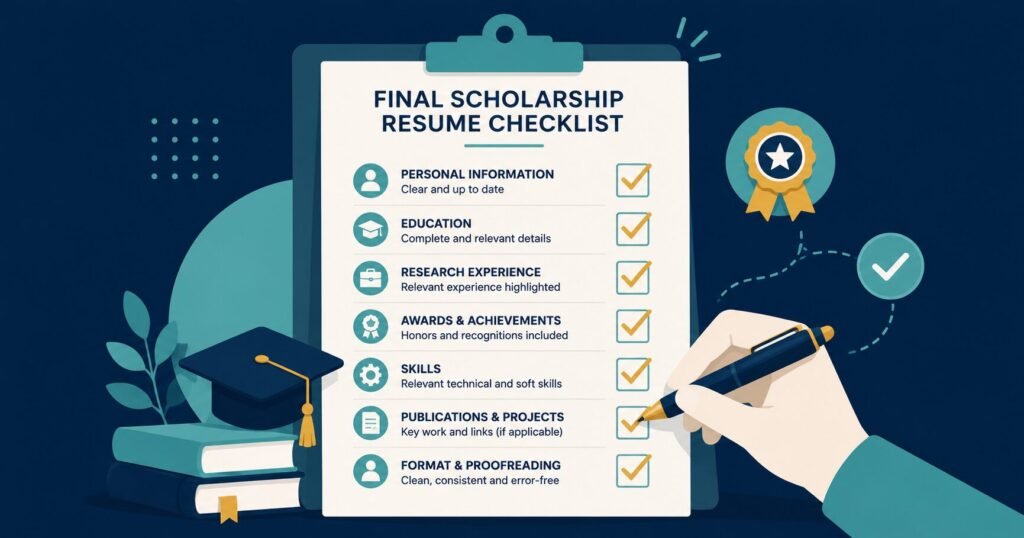
Before submitting, check the following.
- The document follows the scholarship’s page limit.
- Your name and contact information are correct.
- Your professional email address works.
- Your strongest academic qualifications appear near the top.
- Degree titles and dates are accurate.
- GPA and ranking information are clear.
- Experience is listed in reverse chronological order.
- Achievement statements use strong action verbs.
- Important results include useful numbers.
- Skills are specific and relevant.
- Language levels are honest.
- Unnecessary personal information has been removed.
- The design is clean and readable.
- Font, spacing, and dates are consistent.
- Spelling and grammar have been checked.
- The scholarship resume / academic CV has been tailored to the scholarship.
- The file has been saved as a PDF.
- The file name is professional.
- All information can be supported if requested.
- The scholarship resume / academic CV complements rather than repeats the motivation letter.
Frequently Asked Questions
What is a scholarship resume / academic CV?
It is an academic and professional summary created to support a scholarship application.
How to build a scholarship resume / academic CV?
Start with your contact information and academic profile, then add education, achievements, research, experience, leadership, volunteering, awards, skills, languages, and relevant training. Tailor the order and content to the scholarship.
How long should a scholarship resume / academic CV be?
Most Bachelor’s and Master’s applicants should aim for one or two pages. Research and PhD applicants may need a longer academic CV.
Is a scholarship resume / academic CV different from a job resume?
Yes. A scholarship CV normally places greater emphasis on education, academic achievements, research, leadership, and community involvement.
Should I include a personal statement?
A short academic profile can help, but it should not exceed three or four lines.
Should I include a photograph?
Only when the scholarship or institution requests or clearly expects one.
Should I include my GPA?
Yes, when it is strong or required.
Should I include class ranking?
Yes. Ranking can make academic performance easier to understand.
Can I include secondary school?
Bachelor’s applicants should normally include it. Master’s and PhD applicants may remove it unless relevant.
What should I include when I have no work experience?
Include academic projects, research, volunteering, leadership, competitions, student activities, technical skills, and independent projects.
Should I include online courses?
Include only courses that are relevant, credible, and useful to the scholarship application.
Should I add references?
Only when requested. Many scholarships collect references separately.
Can I use Canva?
You can, but choose a simple template. Avoid graphics, excessive colours, skill bars, and complicated layouts.
Can I use Europass?
Use it when the scholarship requests it. Otherwise, a concise custom CV may be more effective.
Should I include hobbies?
Include hobbies only when they demonstrate achievement, discipline, leadership, creativity, or community involvement.
Should I include all certificates?
No. Prioritise the most relevant and meaningful ones.
Should I list responsibilities or achievements?
Focus mainly on achievements and contributions.
Can I use the same scholarship resume / academic CV for every application?
Use the same basic information, but tailor the profile, section order, and emphasis for each scholarship.
What file format should I use?
PDF is usually the best format unless the application requests Word or another file type.
What should the file be called?
Use your name and document type, such as Ayesha_Khan_Scholarship_CV.pdf.
Should I use colour?
Limited and professional colour can be acceptable, but a black and white document is completely suitable.
Should I include nationality and date of birth?
Only when requested or clearly relevant to eligibility.
Is an academic resume required for every scholarship?
Not every scholarship asks for one, but many applications require a CV or resume.
Can a scholarship resume / academic CV be more than two pages?
Yes, particularly for PhD applicants, researchers, and experienced professionals. Follow the application instructions.
How do I make my scholarship resume / academic CV stand out?
Use specific achievements, measurable results, clear academic direction, relevant experience, and a clean structure.
Should the scholarship resume / academic CV match the statement of purpose?
Yes. Both documents should present a consistent academic and professional direction.
What is the biggest scholarship resume / academic CV mistake?
Submitting a generic list of activities without explaining their relevance, contribution, or results.
Final Thoughts
A strong scholarship resume / academic CV should make your qualifications easy to understand.
It should not try to impress the committee through decoration or complicated language.
It should demonstrate:
- Academic preparation
- Achievement
- Initiative
- Leadership
- Research or professional potential
- Community contribution
- Clear future direction
The most effective approach is to select experiences carefully and describe them with evidence.
Instead of listing every activity, focus on the experiences that explain why you are prepared for the scholarship and how you may use the opportunity.
The final document should be accurate, focused, professional, and tailored to the programme.
A scholarship resume / academic CV does not need to show that you have done everything.
It needs to show that what you have done has prepared you for the opportunity you are now seeking.