
Taiwan ICDF Scholarship Guide | Taiwan
The TaiwanICDF Scholarship is a comprehensive international scholarship for eligible students from Taiwan’s partner countries and selected developing countries.
It supports English-taught Bachelor’s, Master’s, and PhD programmes offered through participating universities in Taiwan. The programme is administered by the International Cooperation and Development Fund, commonly known as TaiwanICDF, through the Taiwan International Cooperation Alliance.
The scholarship provides round-trip economy airfare, university tuition, credit fees, student accommodation, insurance, approved textbook expenses, and a monthly living allowance. The monthly amount published in the latest detailed guidebook is NT$15,000 for Bachelor’s students, NT$18,000 for Master’s students, and NT$20,000 for PhD students.
Applications for the 2027 TaiwanICDF Scholarship will be accepted from December 1, 2026 to March 15, 2027. Applicants must complete the TaiwanICDF online application and satisfy the separate admission requirements of their chosen partner university.
The scholarship is not open to every nationality. Applicants must be citizens of countries included in the official beneficiary list. The latest detailed country list currently available is contained in the 2026 guidebook, while TaiwanICDF has already announced the application dates for the 2027 intake. Applicants should check the new guidebook when it is published because country and programme availability may change.
Knowing how to get the TaiwanICDF Scholarship requires more than submitting an online form. You must choose an eligible programme, meet the university’s academic requirements, complete both application processes, follow any instructions from the relevant Taiwan representative office, and present a strong connection between your education and the development needs of your country.
This guide explains the scholarship benefits, eligible countries, supported degree levels, university application process, programme selection, documents, application deadlines, assessment stages, and practical ways to improve your application.
What Is the TaiwanICDF Scholarship?
The TaiwanICDF International Higher Education Scholarship Program supports students who want to complete a recognised degree at one of TaiwanICDF’s partner universities.
The programme was established to strengthen human resources and support the social and economic development of partner countries. TaiwanICDF works with Taiwanese universities through the Taiwan International Cooperation Alliance, also known as TICA.
The academic programmes are designed around development-related areas and are taught in English. TaiwanICDF encourages graduates to use their education to contribute to sustainable development after returning home or continuing their professional careers.
The latest detailed guidebook currently linked by TaiwanICDF lists 32 programmes for the 2026 intake. These include Bachelor’s, Master’s, and PhD options, although the exact number and programme list for 2027 may change.
Latest Application Status
The 2027 TaiwanICDF Scholarship application period will run from:
Opening date: December 1, 2026
Closing date: March 15, 2027
The application is completed through the official TaiwanICDF online application system. Applicants must provide accurate and complete information because incomplete or incorrect applications may not be processed.
The official TaiwanICDF website currently confirms the 2027 application dates but still links to the detailed 2026 application guidebook and programme list.
Applicants should use the 2026 materials for early preparation while checking for an updated 2027 guidebook before submitting the final application.
The scholarship offers admission for the autumn semester only. Spring admission is not available.
Who Can Apply?
Applicants must satisfy both TaiwanICDF eligibility rules and the admission requirements of their selected university.
The general conditions include:
- Citizenship of an eligible beneficiary country
- Compliance with any additional conditions established for that country
- No Taiwanese nationality or overseas Taiwanese student status
- Admission eligibility for the selected TICA programme
- Ability to qualify for the required Taiwan resident visa and Alien Resident Certificate
- No simultaneous Taiwan government-funded scholarship
- No previous scholarship revocation by a Taiwan government organisation
- No previous expulsion from a Taiwanese university
- Submission of the highest completed diploma before the required deadline
Meeting the general conditions does not guarantee selection.
Applicants must also meet the academic, professional, language, and document requirements of their chosen university programme.
Eligible Countries
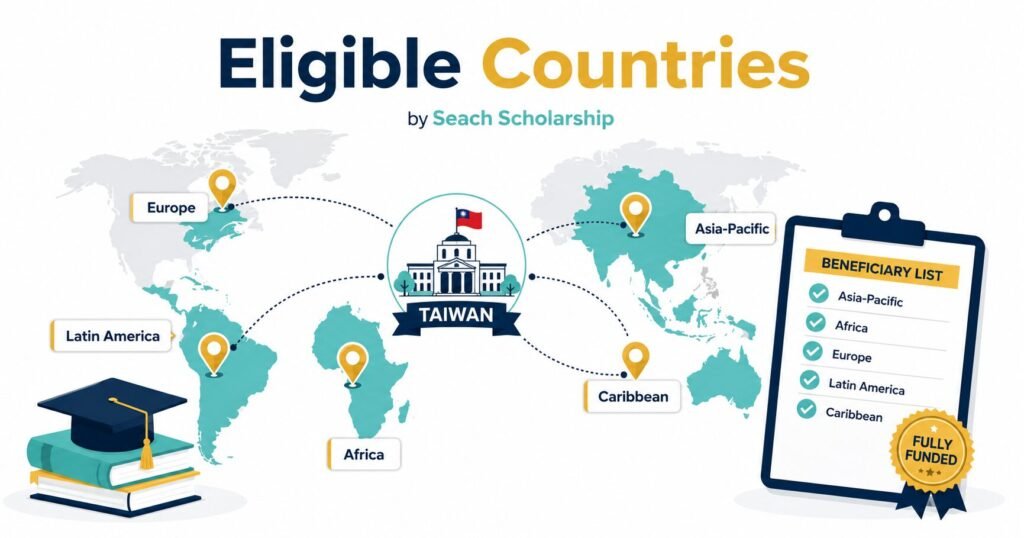
The TaiwanICDF Scholarship is limited to applicants from countries on its official beneficiary list.
The 2026 guidebook lists eligible countries across Asia and the Pacific, West Asia, Europe, Africa, Central America, South America, and the Caribbean.
Asia and the Pacific
The published list includes:
- Fiji
- India
- Indonesia
- Laos
- Malaysia
- Marshall Islands
- Myanmar
- Palau
- Papua New Guinea
- Philippines
- Sri Lanka
- Thailand
- Timor-Leste
- Tuvalu
- Vietnam
West and Central Asia
The published list includes:
- Jordan
- Mongolia
- Russia
- Türkiye
Europe
The list includes:
- Albania
- Bosnia and Herzegovina
- Hungary
- Kosovo
- Latvia
- Montenegro
- North Macedonia
- Poland
- Serbia
Africa
The list includes:
- Côte d’Ivoire
- Djibouti
- Eswatini
- Ethiopia
- Kenya
- Senegal
- South Africa
- Somaliland
- Tanzania
- Uganda
Central America
The list includes:
- Belize
- Guatemala
- Mexico
South America
The list includes:
- Argentina
- Bolivia
- Brazil
- Colombia
- Ecuador
- Paraguay
- Peru
- Uruguay
Caribbean
The list includes:
- Haiti
- St. Kitts and Nevis
- St. Lucia
- St. Vincent and the Grenadines
This list is based on the detailed 2026 guidebook. Applicants for 2027 should verify the updated list when the new guidebook becomes available.
Country Eligibility in South and Central Asia
The scholarship should not be described as open to every country in South Asia or Central Asia.
In the latest detailed list, India and Sri Lanka are included. Bangladesh, Bhutan, Nepal, Maldives, Afghanistan, and Pakistan are not included in that published guidebook.
The published list also does not include Kazakhstan, Kyrgyzstan, Tajikistan, Turkmenistan, or Uzbekistan.
Mongolia, Russia, Türkiye, and Jordan are included under the programme’s West Asia category.
An applicant whose country does not appear on the beneficiary list cannot apply. TaiwanICDF confirms this directly in its official FAQs.
Because country eligibility can change between application cycles, applicants should check the 2027 guidebook rather than relying permanently on the 2026 list.
Bachelor’s Country Restrictions
Bachelor’s programmes are more restricted than Master’s and PhD programmes.
Only applicants from countries that maintain diplomatic relations with Taiwan may apply for the Bachelor’s programmes. These countries are marked with an asterisk in the official guidebook.
The marked countries in the latest detailed list include:
- Belize
- Eswatini
- Guatemala
- Haiti
- Marshall Islands
- Palau
- Paraguay
- St. Kitts and Nevis
- St. Lucia
- St. Vincent and the Grenadines
- Tuvalu
An applicant from another eligible beneficiary country may still qualify for a Master’s or PhD programme but may not qualify for a Bachelor’s programme.
Eligible Degree Levels
The TaiwanICDF Scholarship can support:
- Bachelor’s programmes
- Master’s programmes
- PhD programmes
However, the programme available to an individual applicant depends on nationality and the courses offered during that application cycle.
Applicants can apply only to programmes included in the official TaiwanICDF and TICA list.
A student cannot select an unrelated degree at a Taiwanese university and ask TaiwanICDF to fund it. TaiwanICDF confirms that the scholarship is exclusively for partner schools and programmes within TICA.
Bachelor’s Programmes
The latest detailed guidebook includes selected English-taught Bachelor’s programmes in engineering, electrical engineering, computer science, and advanced technology.
Bachelor’s opportunities are available only to applicants from countries that maintain diplomatic relations with Taiwan.
Applicants normally need a recognised secondary school qualification and must meet the programme’s academic and language requirements.
The precise Bachelor’s list for 2027 should be confirmed when the new programme guide is published.
Master’s Programmes
Master’s programmes represent the largest part of the TaiwanICDF programme list.
The latest detailed guidebook includes programmes in areas such as:
- Tropical agriculture
- Aquaculture technology and management
- International agriculture
- Business administration
- Technology management
- Human resource development
- Tourism and hospitality
- International health
- Health care administration
- Pharmacy
- Information systems
- Electrical engineering and computer science
- Remote sensing
- Electric power engineering
- Industrial engineering
- Civil engineering
- Natural hazards management
- Artificial intelligence
- Educational leadership
- International studies
- Arts and creative industries
- Urban governance
- Semiconductor technology
The exact courses and universities may change in the 2027 intake.
PhD Programmes
The latest detailed programme guide includes PhD options in:
- Tropical agriculture
- International health
- Global health and health security
PhD applicants must satisfy the academic and research requirements of the selected university.
A university may request a research proposal, potential supervisor information, academic publications, recommendation letters, or evidence of previous research experience.
These additional requirements are set by the university rather than by one universal TaiwanICDF rule.
Available Fields of Study
TaiwanICDF programmes focus on areas connected with human resource development and sustainable economic and social progress.
The latest programme guide includes subjects within:
- Agriculture
- Business and management
- Public health and medicine
- Engineering and science
- Education
- International affairs and governance
- Arts and creative industries
All programmes included in the guidebook are conducted in English.
Partner Universities and TICA
The Taiwan International Cooperation Alliance is the university network through which the scholarship is delivered.
Applicants must select one approved programme at one TICA university.
They cannot submit TaiwanICDF applications for several universities or programmes during the same application year.
The latest guidebook includes universities such as:
- National Pingtung University of Science and Technology
- National Yang Ming Chiao Tung University
- Taipei Medical University
- National Taiwan Ocean University
- National Chung Hsing University
- National Chengchi University
- National Tsing Hua University
- National Taiwan Normal University
- National Kaohsiung University of Hospitality and Tourism
- National Central University
- National Sun Yat-sen University
- National Cheng Kung University
- National Dong Hwa University
- National Chung Cheng University
- National Taipei University
- Taiwan Tech
- National Chi Nan University
- Other participating institutions included in the annual programme list
Applicants should evaluate the exact programme rather than choosing a university only because of its general reputation.
Scholarship Benefits
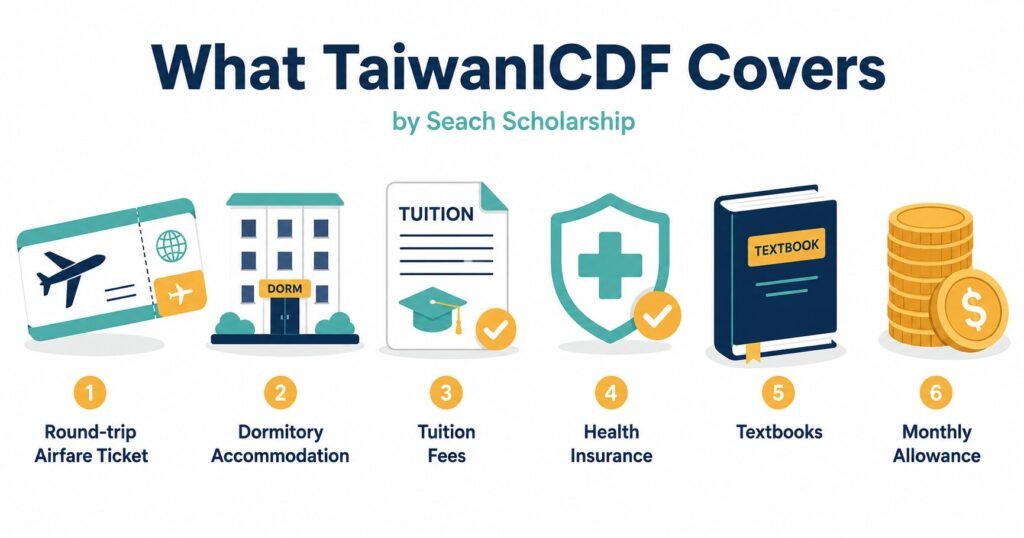
The TaiwanICDF Scholarship provides the following standard benefits during the approved award period:
- Round-trip economy airfare
- Student dormitory accommodation
- University tuition fees
- Credit fees
- Medical and accident insurance
- Approved textbook costs
- Monthly living allowance
TaiwanICDF normally arranges the most direct economy-class flight to and from Taiwan.
Students must follow the travel arrangements provided through the relevant Taiwan embassy, consulate, or representative office.
Tuition and Credit Fees
TaiwanICDF covers tuition fees required by the student’s university.
It also covers the credit fees associated with the number of approved academic credits registered by the student.
This coverage applies to the approved programme and award duration.
Costs connected with extending the programme beyond the scholarship period must be paid by the student.
Student Accommodation
Scholarship recipients are required to live in university student dormitories.
Housing is therefore provided through the scholarship arrangement rather than through an unrestricted private housing allowance.
Students should not assume that the scholarship will pay for private apartments or family accommodation.
The standard housing arrangement is intended for the scholarship recipient.
Insurance
The scholarship covers student safety insurance together with accidental and necessary medical coverage during the programme.
The programme terms also state that TaiwanICDF covers medical and accident insurance upon arrival and supports enrolment in Taiwan’s National Health Insurance system from the seventh month of residence, subject to the programme rules.
Applicants should read the insurance policy carefully because not every treatment or personal health expense will necessarily be covered.
Textbook Costs
Textbooks required by instructors may be covered when approved by the director of the student’s institute.
This does not mean students receive an unrestricted annual book allowance.
The books must normally be academically required and approved through the programme.
Monthly Living Allowance
The latest detailed guidebook states the following monthly allowances:
Bachelor’s Students
NT$15,000 per month
Master’s Students
NT$18,000 per month
PhD Students
NT$20,000 per month
The allowance is deposited monthly into the student’s local bank account and is intended for food and miscellaneous living expenses.
Applicants should confirm whether these amounts remain unchanged in the 2027 guidebook.
Is the TaiwanICDF Scholarship Fully Funded?
Yes. The TaiwanICDF Scholarship can reasonably be described as a fully funded degree scholarship because it covers the principal costs of tuition, credit fees, accommodation, insurance, textbooks, airfare, and living support.
However, fully funded does not mean that every possible expense is paid.
Applicants may still need personal funds for:
- Passport expenses
- Visa fees
- Transit visas
- Extra baggage
- Personal travel
- Clothing
- Mobile services
- Additional academic materials
- Family expenses
- Programme extensions
- Costs above the monthly allowance
TaiwanICDF specifically states that visa costs are paid by the student and that there is no separate relocation allowance.
Expenses Not Covered
Applicants should prepare personal funds for costs such as:
- Passport issuance or renewal
- Taiwan visa charges
- Transit visa fees
- Optional stopovers
- Travel that is not arranged by TaiwanICDF
- Personal electronics
- Private accommodation
- Spouse or dependant expenses
- Additional study time after scholarship expiration
- Expenses exceeding the living allowance
TaiwanICDF arranges direct travel and states that no stopover allowance is provided.
Academic Requirements
TaiwanICDF does not publish one universal GPA requirement for every programme.
Applicants must meet the admission criteria of the university and degree to which they apply.
A university may assess:
- Previous grades
- Relevance of the applicant’s qualification
- Academic ranking
- Research experience
- Professional experience
- Study plan
- Statement of purpose
- Recommendation letters
- English language ability
- Interview performance
The exact assessment varies between programmes.
Is There a Minimum GPA?
There is no single TaiwanICDF minimum GPA stated in the general scholarship rules.
Individual partner universities may publish their own grade requirements.
A competitive applicant should still demonstrate:
- Strong and consistent grades
- Good performance in relevant subjects
- Academic or professional achievements
- Clear preparation for the selected programme
- Potential to contribute after graduation
Applicants should explain their grading system, class rank, and academic awards when these details make their results easier to understand.
English Language Requirements
TaiwanICDF itself does not require one universal English proficiency examination.
However, the selected university or academic programme may require IELTS, TOEFL, another accepted test, or alternative evidence of English proficiency.
Applicants should never assume that studying previously in English will automatically provide an exemption.
They should check the programme’s admission page for:
- Accepted tests
- Minimum scores
- Exemption conditions
- Document deadlines
- Validity periods
All scholarship programmes are taught in English, so applicants must be able to study, communicate, write assignments, and complete examinations in English.
Is There an Age Limit?
TaiwanICDF’s official FAQ states that there is no general age limit.
Applicants are evaluated comprehensively rather than being accepted or rejected on the basis of age alone.
An individual university may still use academic or professional requirements that affect whether an applicant is suitable for a programme.
Documents to Prepare
The exact document list depends on the selected programme and the responsible Taiwan representative office.
Applicants should be prepared to provide:
- TaiwanICDF online application information
- Passport or identity documentation
- Highest completed diploma
- Academic transcripts
- University admission documents
- English proficiency evidence where required
- Study plan or statement of purpose
- Curriculum vitae where required
- Employment evidence where required
- Research proposal for certain PhD programmes
- Recommendation letters where required by the university
- Any forms requested by the Taiwan embassy or representative office
TaiwanICDF requires applicants to complete its online application and separately submit every document required by the selected university before the university’s admission deadline.
Are Recommendation Letters Required?
TaiwanICDF does not impose a general scholarship recommendation-letter requirement.
However, the selected university may require one or more recommendation letters as part of its admission process.
Applicants should follow the university’s requirements even when a document is not required by TaiwanICDF itself.
Highest Diploma Deadline
Applicants must provide their highest-level diploma before July 31 of the year of enrolment.
Failure to provide the diploma by the required date can result in cancellation of the scholarship.
The exact date for the 2027 intake should be confirmed in the new guidebook.
Final-year students should make sure their university can issue the required graduation documentation on time.
How to Get the TaiwanICDF Scholarship
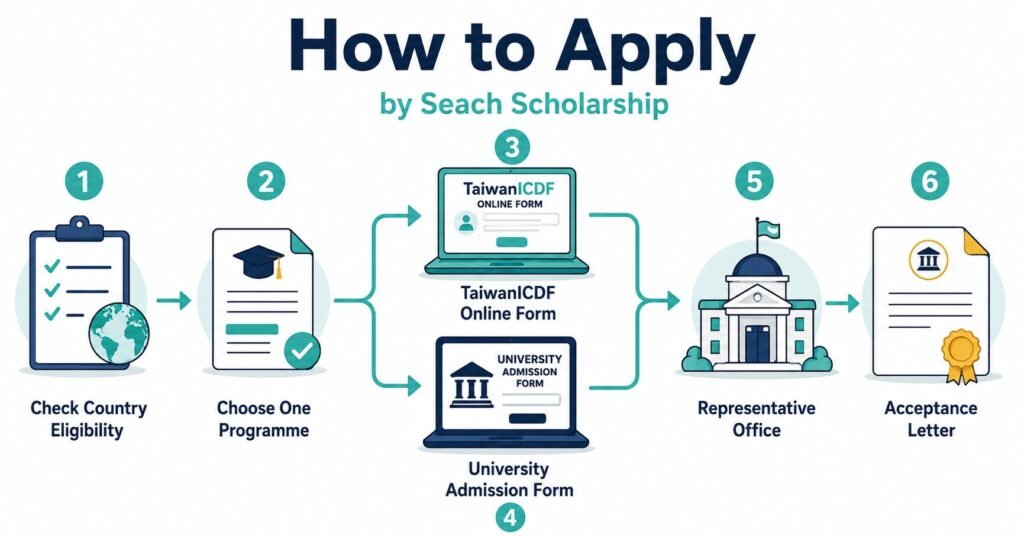
To understand how to get the TaiwanICDF Scholarship, applicants should focus on six essential areas.
Confirm Country Eligibility
Check the annual beneficiary-country list before preparing the application.
A strong academic profile cannot compensate for an ineligible nationality.
Choose the Correct Programme
Applicants may apply to only one TICA programme each year.
Choose a programme that closely matches your previous education, professional experience, and future plans.
Meet the University Requirements
The scholarship application and university admission application are separate.
Complete both processes before their respective deadlines.
Demonstrate Development Relevance
TaiwanICDF programmes are intended to strengthen human resources and contribute to sustainable development in partner countries.
Explain how the selected degree will help you address a real economic, social, health, education, agriculture, technology, or governance challenge.
Prepare Complete Documents
Incomplete or inaccurate information can stop the application from being processed.
Follow the Taiwan Representative Office’s Instructions
Some applicants must submit additional documents to the responsible Taiwan embassy, consulate, representative office, or technical mission.
The required format may differ by country.
Step-by-Step Application Process
Step 1: Check the Beneficiary-Country List
Confirm that your nationality appears in the current TaiwanICDF guidebook.
Bachelor’s applicants must also confirm that their country is eligible for undergraduate study.
Step 2: Review the Available Programmes
Study the annual list of TICA universities and programmes.
Compare:
- Degree level
- Academic requirements
- English requirements
- Programme content
- University location
- Research areas
- Admission deadline
- Career relevance
Step 3: Choose One Programme
Applicants may apply to only one TaiwanICDF programme and one TICA university during an application year.
Step 4: Create an Online Application
The 2027 application system opens on December 1, 2026.
Complete every required section and verify the accuracy of your personal, academic, and programme information.
Step 5: Complete the University Application
Apply separately to the partner university.
The TaiwanICDF application does not automatically create a university admission application.
Step 6: Contact the Taiwan Representative Office
Determine whether your country’s office requires:
- Printed application documents
- Electronic copies
- Certified records
- Interviews
- Government nomination
- Additional country-specific forms
Whether hard or electronic copies are required is decided by the individual Taiwan representative office.
Step 7: Submit Before Both Deadlines
The TaiwanICDF deadline and university admission deadline may not be identical.
Applicants must meet both.
Step 8: Prepare for an Interview
A university or Taiwan representative office may conduct an interview or request additional information.
Prepare to discuss:
- Your academic background
- Reasons for selecting the programme
- Professional goals
- Development challenges in your country
- How you will apply the degree after graduation
Step 9: Wait for the Review Process
The Taiwan representative office conducts an initial review.
Qualified applicants then proceed to a second review conducted by the partner university’s academic committee in cooperation with TaiwanICDF representatives.
Step 10: Receive the Official Scholarship Decision
University admission alone does not mean that the applicant has received the scholarship.
Only applicants who receive an official TaiwanICDF Acceptance Letter are scholarship recipients.
Embassy or Representative Office Review
The relevant Taiwan embassy, consulate, representative office, or technical mission may verify the applicant’s credentials and conduct the first review.
It then submits recommended applicants to TaiwanICDF.
The office may consider:
- Eligibility
- Document authenticity
- Academic preparation
- National development relevance
- Professional background
- Country-specific priorities
Applicants should communicate professionally and provide all requested information promptly.
University and TaiwanICDF Selection
Qualified applications undergo a second review through an academic committee organised by the partner university in cooperation with TaiwanICDF.
The committee considers the university’s admission criteria together with TaiwanICDF eligibility and selection requirements.
This means an applicant must be competitive in two areas:
- Admission to the academic programme
- Selection for TaiwanICDF funding
Receiving only the university admission letter is not enough.
How to Write a Strong Study Plan
A strong study plan should connect your previous education, selected programme, professional goals, and future contribution.
A useful structure includes the following sections.
Academic Background
Explain your previous degree, relevant subjects, strongest grades, research, and academic achievements.
Professional or Community Experience
Discuss employment, internships, projects, leadership, volunteering, or public service connected with the field.
Development Challenge
Identify a specific problem affecting your country or region.
Examples may include:
- Agricultural productivity
- Food security
- Public health systems
- Digital infrastructure
- Renewable energy
- Education management
- Disaster resilience
- Urban governance
- International trade
- Skilled workforce development
Programme Fit
Explain how the selected TICA programme provides the knowledge and practical skills needed to address that challenge.
Future Plan
Describe what you intend to do after graduation.
Avoid vague statements about simply helping your country.
Explain:
- The sector where you plan to work
- The role you hope to perform
- The project or system you want to improve
- The people or institutions that may benefit
How to Improve Your Chances
Check Eligibility Before Applying
Do not prepare a long application before confirming that your nationality and degree level qualify.
Choose the Programme Carefully
You can apply to only one programme.
Select the option with the strongest connection to your background.
Research the University
Understand the curriculum, faculty, practical training, research, and career focus.
Demonstrate Academic Strength
Provide clear evidence of:
- Strong grades
- Class ranking
- Academic awards
- Research experience
- Relevant projects
- Publications where applicable
Show Development Impact
Explain how the degree connects with a real need in your country or region.
Use Specific Examples
Do not write only that you are hardworking or passionate.
Explain what you have achieved.
Follow Both Application Processes
Complete the TaiwanICDF application and the university application.
Contact the Representative Office Early
Do not wait until March to ask whether additional country documents are required.
Prepare for Language Requirements
TaiwanICDF may not require IELTS or TOEFL, but the university might.
Submit Before March 15
Technical problems and missing documents are easier to resolve when the application is submitted early.
Application Deadline
The confirmed application dates for the 2027 TaiwanICDF Scholarship are:
Opening date: December 1, 2026
Closing date: March 15, 2027
Applicants should also confirm:
- The university admission deadline
- The representative office deadline
- Interview dates
- Diploma submission deadline
- Any programme-specific deadline
The university deadline may differ from the central scholarship deadline.
Scholarship Results
The 2026 guidebook states that TaiwanICDF normally announces scholarship recipients no later than June 10 each year.
Successful applicants receive the TaiwanICDF Acceptance Letter through the Taiwan embassy, consulate, or representative office where they applied.
Applicants should wait for the 2027 guidebook before treating June 10, 2027 as a confirmed result date.
The official scholarship decision is separate from university admission.
Can the Scholarship Be Deferred?
No.
TaiwanICDF does not allow recipients to defer the scholarship to a later intake.
A selected applicant who cannot enrol must normally apply again in a future year.
Can Applicants Change Their Programme?
No.
Applicants cannot change their selected programme after submitting the application.
A recipient who changes to another TICA programme after selection can have the scholarship cancelled.
This is why programme research should be completed before submitting the application.
Can the Scholarship Be Extended?
No.
The scholarship cannot be extended beyond its approved duration.
Any additional study period must be financed by the student.
Students should choose realistic research plans and complete academic requirements on schedule.
Common Application Mistakes
Applying From an Ineligible Country
Only citizens of countries on the beneficiary list may apply.
Assuming Every Eligible Country Can Apply for a Bachelor’s Degree
Bachelor’s programmes are restricted to countries maintaining diplomatic relations with Taiwan.
Applying to More Than One Programme
Applicants may select only one TICA programme.
Completing Only the TaiwanICDF Form
The separate university application must also be completed.
Missing the University Deadline
The university may use a different deadline from March 15.
Assuming University Admission Means Scholarship Selection
Only an official TaiwanICDF Acceptance Letter confirms the scholarship.
Ignoring the Representative Office
Country offices may require additional documents or an interview.
Providing Incomplete Information
Incorrect or incomplete information can prevent processing.
Submitting a General Study Plan
Connect the programme with a specific development or professional objective.
Ignoring English Requirements
The university may require a language test even though TaiwanICDF does not.
Applying for an Unlisted Programme
The scholarship is limited to approved TICA programmes.
Assuming Every Expense Is Covered
Applicants must pay costs such as visa fees, passport costs, and personal expenses.
Depending on Another Taiwan Government Scholarship
Recipients cannot hold another Taiwan government-sponsored scholarship during the same academic year.
Frequently Asked Questions
What is the TaiwanICDF Scholarship?
How to get the TaiwanICDF Scholarship?
Is the TaiwanICDF Scholarship fully funded?
How much is the monthly allowance?
Does the scholarship cover airfare?
Does it cover tuition?
Does it provide accommodation?
Does it cover insurance?
Does it pay visa fees?
Does it cover passport expenses?
Is there a separate relocation allowance?
Can applicants from every country apply?
Can students from India apply?
Can students from Sri Lanka apply?
Can students from Bangladesh apply?
Can students from Nepal apply?
Can students from Pakistan apply?
Can students from Central Asia apply?
Can students from Türkiye apply?
Can African students apply?
Does the scholarship fund Bachelor’s degrees?
Does it fund Master’s degrees?
Does it fund PhD programmes?
Are programmes taught in English?
Is IELTS compulsory?
Is there an age limit?
Is there a minimum GPA?
Are recommendation letters required?
Can applicants apply to several programmes?
Is the online application free?
Do I need to apply separately to the university?
Do I need to contact the Taiwan embassy?
Does university admission guarantee the scholarship?
Can unsuccessful applicants apply again?
Can the scholarship be deferred?
Is spring admission available?
Can the programme be changed after applying?
Can recipients hold another Taiwan government scholarship?
When do 2027 applications open?
What is the 2027 deadline?
When are results announced?
Final Thoughts
The TaiwanICDF Scholarship is one of Taiwan’s most comprehensive international scholarship programmes.
It provides round-trip travel, tuition, credit fees, accommodation, insurance, textbook support, and a monthly living allowance for eligible Bachelor’s, Master’s, and PhD students.
However, it is not open to every country or every programme.
A competitive applicant should:
- Confirm country eligibility
- Check whether the intended degree level is available
- Choose one approved TICA programme
- Meet the university’s academic requirements
- Complete both application processes
- Contact the responsible Taiwan representative office
- Prepare a focused study plan
- Demonstrate academic and professional potential
- Explain the future development value of the degree
- Submit all materials before March 15, 2027
The main answer to how to get the TaiwanICDF Scholarship is to build one clear and consistent application.
Your previous education, chosen programme, professional plans, and future contribution should all show why the scholarship is a logical investment in both your career and the development of your country or region.